


 Español
 Français
 Pусский
 繁體中文
繁體中文 简体中文
简体中文 Select another language


arking a century and a half of horological excellence, the 150 Heritage pocket watch is a creation that celebrates the history of humankind, bridging centuries of astronomical observation, technical mastery and craftsmanship. At its heart beats Calibre 1150, the new ultra-complicated movement that builds on the core architecture of Calibre 1000, with all activation mechanisms – such as crown-pushers and correctors – entirely reimagined to suit the compact pocket watch format and its intended use.
This limited edition also introduces the Universal Calendar for the first time: a mechanical calculator visible from the caseback and independent of the movement, offering a panoramic view of the celestial cycles that have shaped cultural celebrations across the world. With 47 functions, including 30 complications, the 150 Heritage harmoniously blends complications with intuitive operation, reflecting the brand’s commitment to putting ease of use at the centre of mechanical innovation.
Showcasing an array of métiers d’art, this pocket watch is adorned with hand-engraved platinum, luminous ‘Grand Feu’ enamelling and a hand-made chain, each element celebrating the traditional crafts that characterise Haute Horlogerie. Limited to two one-of-a-kind platinum editions, these references stand as a tribute to the generations of artisans, engineers and visionaries who have shaped Audemars Piguet’s legacy . The first ultra-complicated watch truly designed to fit inside a pocket, it lays the foundation for a new horological concept that blends tradition, innovation and modern portability.
Audemars Piguet’s pursuit of mechanical innovation has led to some of the most remarkable timepieces in watchmaking history. In 1899, the Manufacture unveiled L’Universelle, its most complicated pocket watch to date, crafted for Union Glashütte. In 1921, the Manufacture delivered its second ultra-complicated pocket watch – nicknamed La Grosse Pièce2 – to S. Smith & Sons.
More than a century later, this spirit of ingenuity inspired the development of Calibre 1000, introduced with RD#4 in 2023, setting a new benchmark for both complexity and ease of use in a wristwatch. In tribute to this legacy of high complications, the 150 Heritage marks the third ultra-complicated pocket watch in this lineage and inaugurates Calibre 1150 – a new movement which retains Calibre 1000’s core architecture. Far from a simple adaptation, its mechanism has been revisited and reconstructed for optimal operation of the pocket watch.

As this creation is not worn on the wrist, Calibre 1150 has been adapted to a hand-wound format and the oscillating weight removed. Regrouping the Manufacture’s horological savoir-faire into a single movement counting 1,099 components, this feat of Haute Horlogerie tradition brings together 40 functions and 22 complications3, among which a Grande Sonnerie, minute repeater, a semi-Gregorian perpetual calendar, a split-seconds flyback chronograph and a flying tourbillon.
It further incorporates the Manufacture’s most recent R&D innovations – the Supersonnerie technology 4(RD#1), the ultra-thin movement architecture (RD#2) and the oscillator with increased amplitude (RD#3). To preserve visual harmony across the watch’s multiple complications, all calendar indications are displayed in dedicated apertures, keeping the chronograph counters clear and enabling instant, effortless reading of the date.
Going beyond traditional norms of construction, the teams blurred the line between case and movement, revisiting how the movement’s functions are activated. Both the position and role of each crown-pusher and corrector have been optimised through 3D modelling and physical testing to enhance tactile comfort and ease of use, while also ensuring each element is perfectly centred when the pocket watch is closed. This new construction removes any unnecessary controls, prevents accidental activation of functions and ensures the watch comfortably fits inside a pocket.
The crown-pusher at 2 o’clock starts and stops the chronograph, selects the chiming mode – silence, petite sonnerie or grande sonnerie – and activates the minute repeater with a new pull function. At 3 o’clock, the main crown-pusher – placed along the central axis with a rounded bow – handles winding, date correction in both directions, time-setting and the split-seconds hand during chronograph timing using a patented return mechanism linked to the winding stem. The one located at 4 o’clock resets the flyback chronograph and adjusts the month indication – moving forwards or backwards – with the push-piece returning to neutral after each activation for added precision and ease of use.
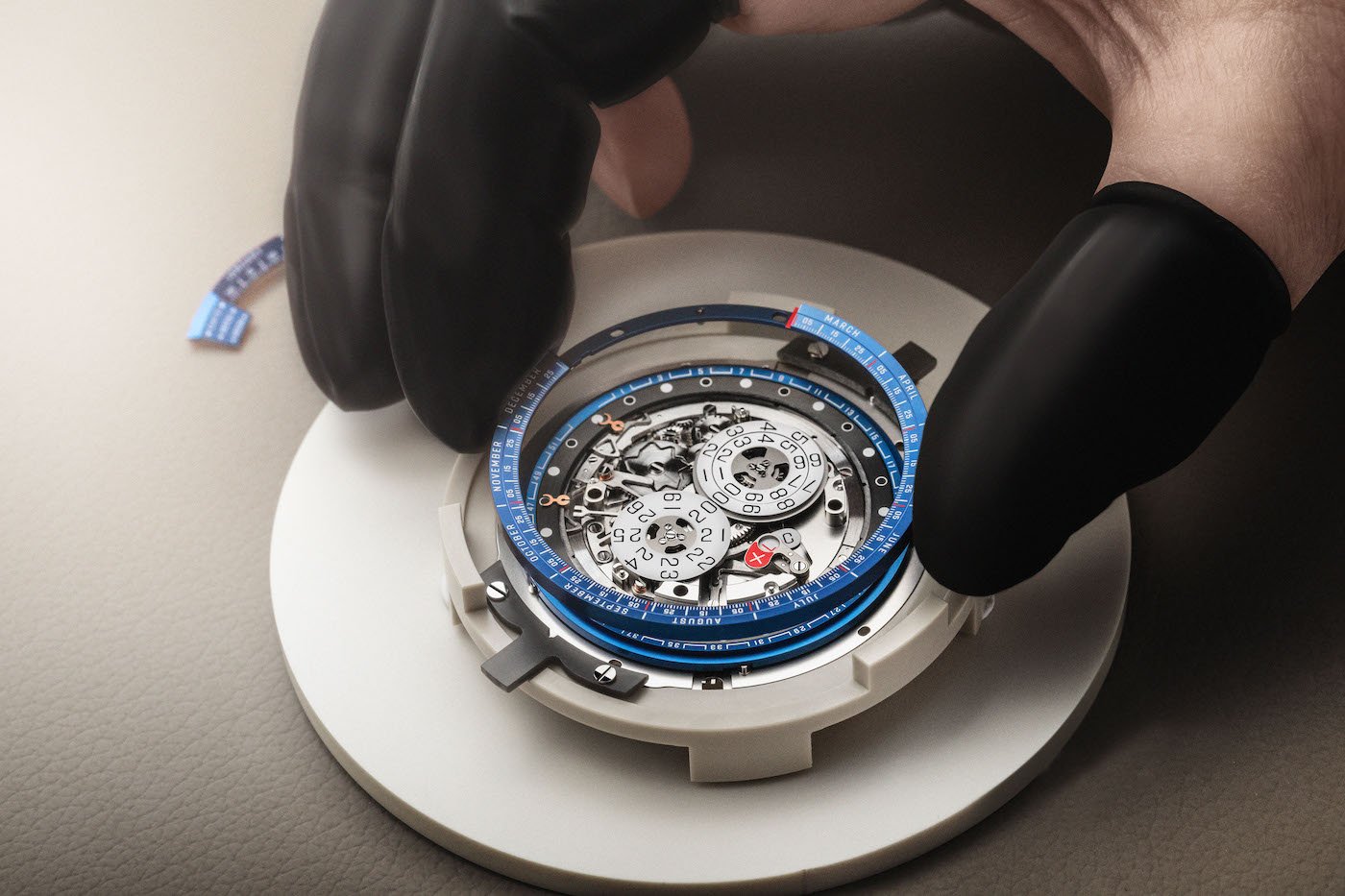
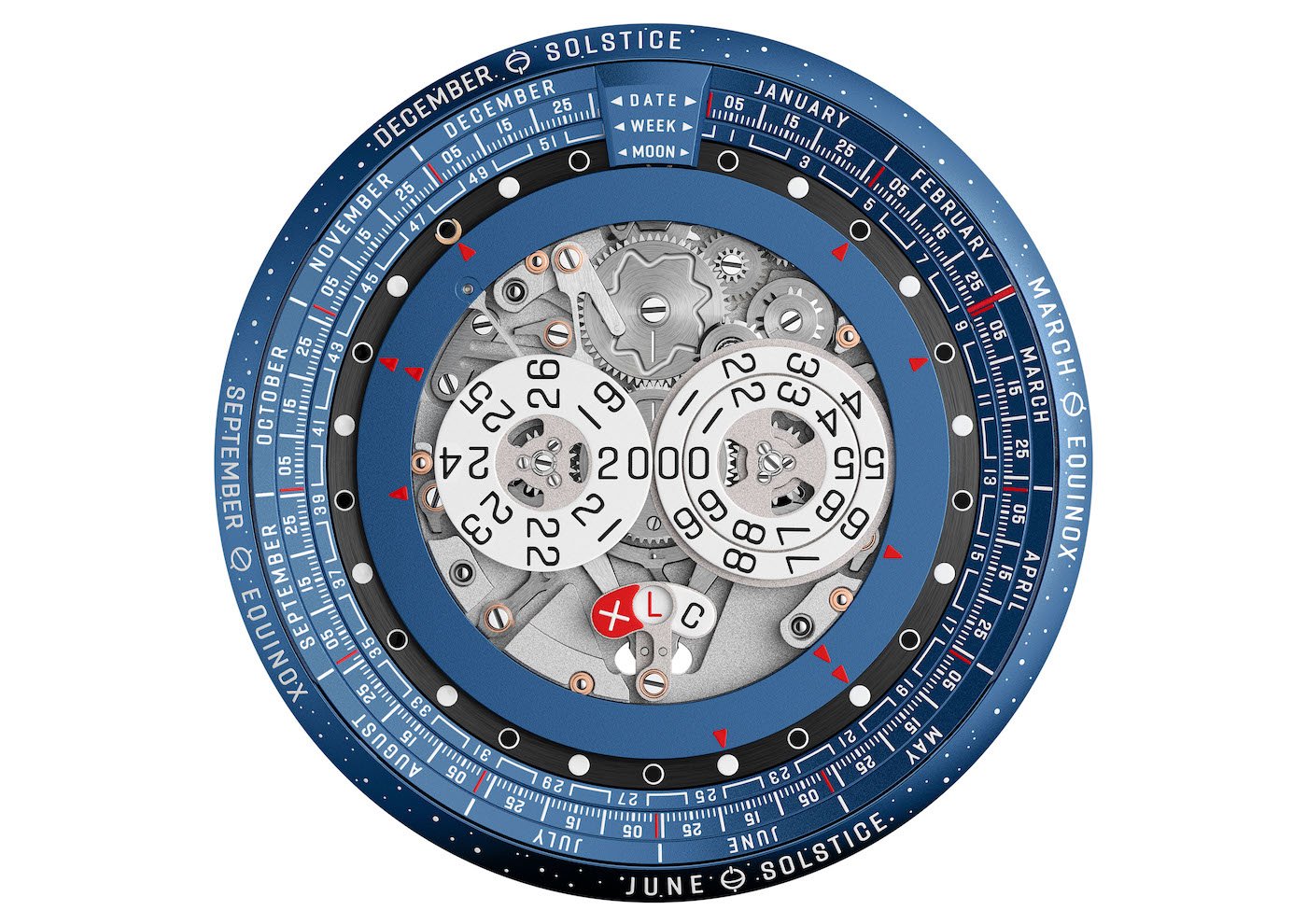
Two additional correctors are discreetly placed inside the caseback, which is accessible via a dedicated push-piece at 6 o’clock. One adjusts the weekday (“WD”), while the other, marked with a crescent, corrects the astronomical moon. Opening the caseback also reveals the Supersonnerie sapphire soundboard, which not only enhances the acoustic performance of the chiming mechanism but also offers a rare view of the intricate architecture and decorations of Calibre 1150. Unveiling more than the movement’s inner workings, the secret caseback opens to 180°, revealing both the main dial and the Universal Calendar – Audemars Piguet’s groundbreaking mechanical lunisolar calendar housed within the back of the watch.
Since the dawn of civilisation, humanity has looked to the skies for guidance. By observing the waxing and waning of the moon and the steady course of the sun, our ancestors established cycles to organise civil, agricultural and cultural life. Despite the lack of communication between disparate groups, their calculations and observations often converged. Archaeological discoveries further reveal a striking coherence in the methods used to track time around the world, as seen in ancient sites and calendars across continents – from Göbekli Tepe in Turkey to Taosi in China and Stonehenge in England.
This shared fascination with the cosmos gave rise to a diversity of calendars – solar, lunar and lunisolar – each reflecting astronomical observations and marking cultural events. Solar calendars, such as the widely adopted Gregorian system, are based on the Earth’s revolution around the Sun, aligning the passage of days with the seasons defined by solstices and equinoxes. Lunisolar calendars, like the Hebrew, Hindu and Chinese systems, count months with lunar phases and years with the solar cycle, while lunar calendars, such as the Islamic calendar, solely follow the phases of the Moon.
Housed in the pocket watch’s caseback cover, the Universal Calendar draws inspiration from humanity’s relationship with the sky. Unlike traditional perpetual calendars, which follow a single time system, this mechanism embraces the plurality of interpretations around the world. Its dial not only presents complex astronomical data but also offers an alternative way to experience time by blending horology with astronomy and tradition.
Using the Gregorian calendar as a reference, the Universal Calendar itself compiles 8 complications which bring together solar, lunar and lunisolar cycles on a single dial for a 360° panorama counting 18 indications: the year, leap years, months, dates, weeks, moon phase and seasonal markers, such as solstices and equinoxes, and nine cultural celebrations drawn from global traditions.
Some celebrations are based on the Sun – Christmas (Sol Invictus) and Saint John’s Day (Inti Raymi); some on the Moon – the beginning of Ramadan; and others are lunisolar, including Diwali, Rosh Hashanah, Pesach, Vesak, Easter and the Chinese New Year. Each event is shown as a consequence of an astronomical phenomenon, creating a strong connection between the cosmos and human tradition.
Operation of this mechanism is both tactile and immediate: a simple turn of the bidirectional wheel in the caseback instantly updates up to two centuries of calendrical cycles. Ranging from 1900 to 2099, a full rotation corresponds to one Metonic cycle5 with all indications updating instantly. As it functions independently of Calibre 1150, it remains synchronised until 2099, regardless of the timepiece’s power reserve.
Crafted in tribute to the astronomers, watchmakers and artisans whose ingenuity has shaped the measurement of time across civilisations, the 150 Heritage pocket watch shines a light on the ancestral savoir-faire that have defined Haute Horlogerie for centuries.
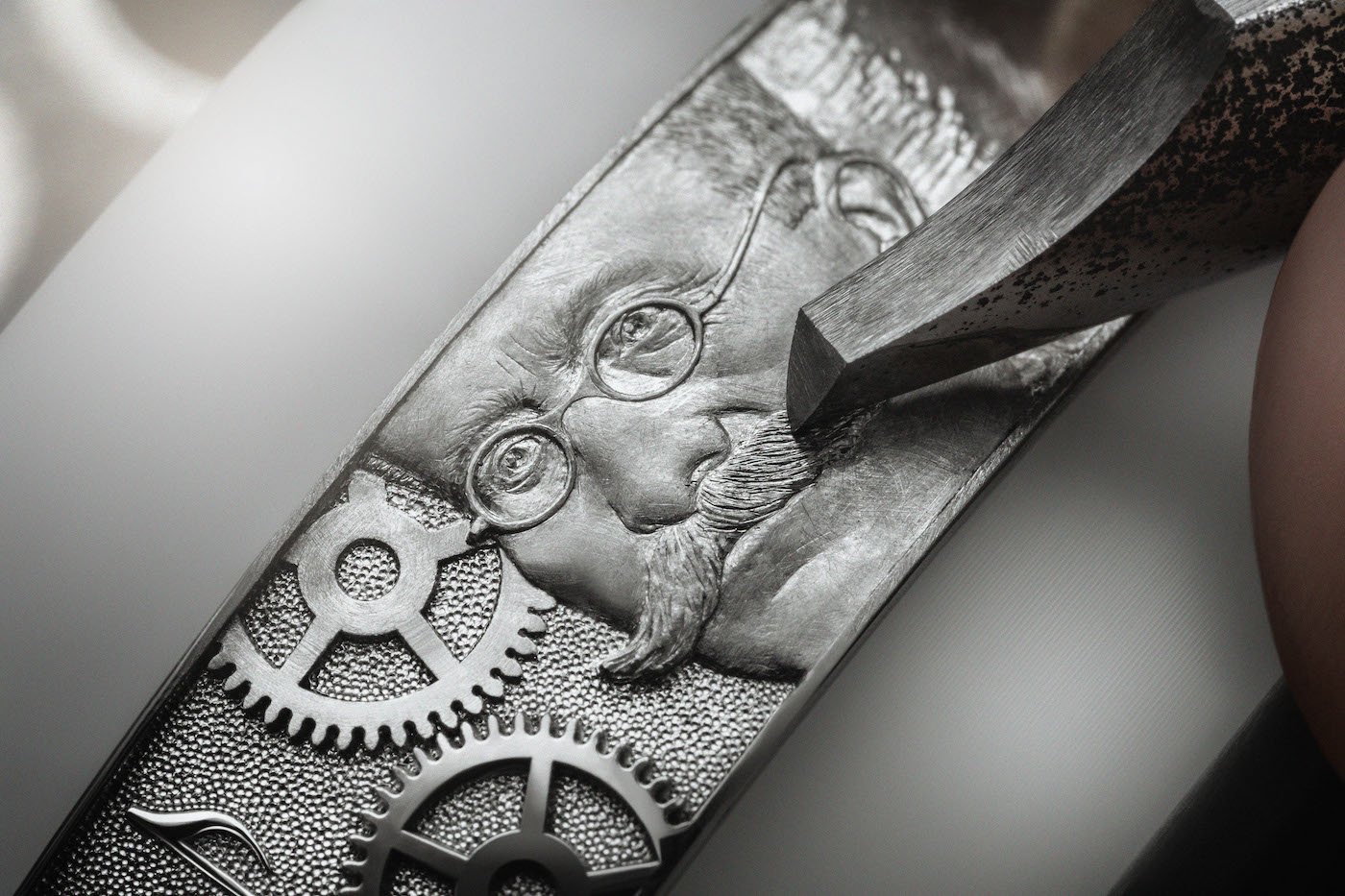
Audemars Piguet has entrusted the decoration of this timepiece to master artisans. The platinum case, chosen for its rarity and deep symbolic value, is entirely hand-engraved – a very rare and demanding craft traditionally reserved for exceptional creations, which serves as the perfect tribute to a century and a half of creativity, savoir-faire, and heritage. By regrouping all chronograph push-pieces and crowns on a small portion of the case flank, the remaining surface becomes a canvas for commemorative motifs and scenes that depict the brand’s history, including portraits of its founders and the dedicated 150-year anniversary logo.
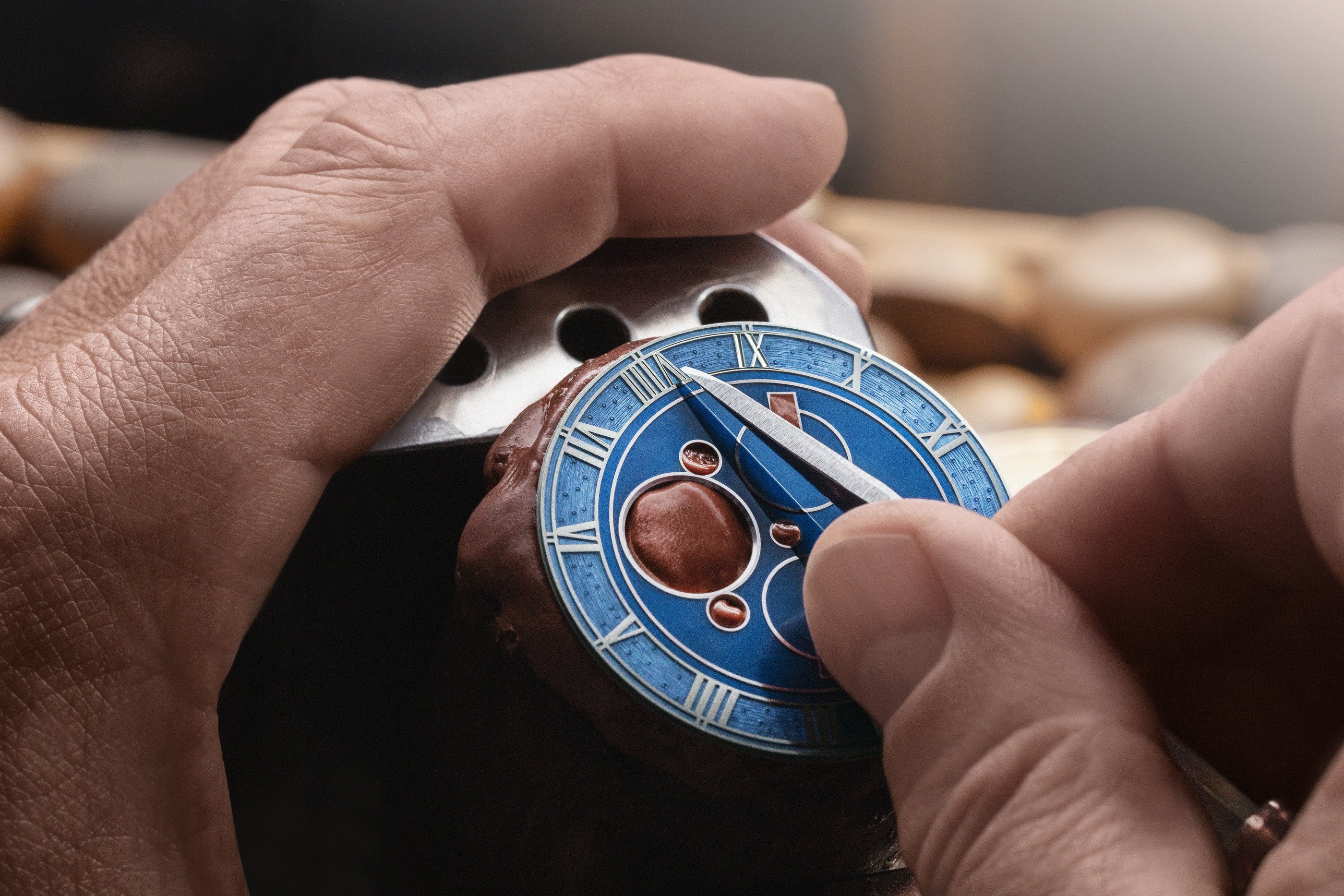
Crafted in 18-carat white gold, the main dial showcases various métiers d’art, featuring blue translucent grand feu enamelling achieved through multiple firings to create luminous depth. Framing the dial, the 18- carat white gold Roman numerals are engraved by hand and sit above star trails evoking the celestial rhythms that have inspired generations of watchmakers – a meticulous decoration done manually that extends to the Universal Calendar dial on the back of the watch, reinforcing the astronomical theme throughout the design. Also hand-engraved, the 18-carat pink gold hands add a touch of contrast for optimal legibility, echoing the tones of the chronograph hands and flying tourbillon bridge.
Completing the timepiece, a hand-made platinum chain pays tribute to the traditional art of chain-making, combining aesthetic harmony with practical elegance. This combination of métiers d’art – engraving, enamelling and chain-making – illustrates how Audemars Piguet perpetuates traditional skills to enrich its creations and contribute to the ongoing evolution of Haute Horlogerie. In addition to the two unique timepieces created in platinum, eight variations in 18-carat white gold will see the light of day, each reflecting the same standards of craftsmanship and attention to detail.
For a century and a half, Audemars Piguet has cultivated a tradition of excellence driven by a consistent pursuit of progress. Since the founders’ earliest school watches in 1875, calendar watches have played a central role in the Manufacture’s technical exploration. This expertise gave rise to two landmark creations: L’Universelle, crafted for Union Glashütte in 1899 and known as the most complex chronograph ever produced by Audemars Piguet, and La Grosse Pièce, delivered in 1921 to the English watchmaker S. Smith & Sons, featuring 18 complications and the most comprehensive calendar functions in the brand’s history.
This pioneering spirit continued throughout the decades. In 1955, the Manufacture introduced the first perpetual calendar wristwatch with leap year indication (Model 5516, Calibre 13VZSSQP), followed in 1978 by the ultra-thin selfwinding perpetual calendar (Model 5548, Calibre 2120/2800) – the thinnest of its time. The launch of Calibre 5134 in 2015 adapted the perpetual calendar to the proportions of the 41 mm Royal Oak case, marking a turning point in ergonomic design.
Calibre 5133 (RD#2) redefined ultra-thin architecture in 2018 by integrating all perpetual calendar functions on a single plane. Five years later, Calibre 1000 (RD#4) combined multiple complications within a single, ergonomic movement. Most recently, calibres 7138 and 7136 introduced last year mark a shift in how complications are imagined at Audemars Piguet, placing comfort and intuitive ergonomics at the heart of the experience while also reflecting a new chapter in the brand’s approach to mechanical development.
As the latest chapter in this lineage, the ultra-complicated hand-wound Calibre 1150 extends the Manufacture’s legacy beyond mechanics, offering a perfect blend of technical and aesthetic refinement.
TECHNICAL SPECIFICATIONS
- FUNCTIONS A total of 47 functions, including 30* complications. Among the highlights: Grande and Petite Sonnerie, Supersonnerie, minute repeater, flying tourbillon, semi-Gregorian perpetual calendar (day, large date, month, year, astronomical moon, moon phases), flyback chronograph, split-seconds, hours and minutes.
- CASE Hand-engraved platinum case, glareproofed sapphire crystal and Supersonnerie soundboard caseback. Case thickness: 23.4 mm
- DIAL Blue translucid enamel dial, 18-carat white gold roman numerals with hand-engraved backdrop, tone-on- tone subdials with silver-grey toned thread and white indications, 18-carat pink gold hand-engraved hands and 18-carat white gold split-seconds hand, white vintage Audemars Piguet signature.
- UNIVERSAL CALENDAR DIAL 18-carat white gold dial with hand-engraved star trails filled with blue translucid enamel, white indications and titanium-toned discs.
- CHAIN Hand-made platinum chain ( 40 cm) fitted with two spring ring clasps.
- MOVEMENT SPECIFICATIONS Hand-wound Calibre 1150 Total diameter 34.3 mm (15 lignes) Total thickness 8.9 mm Number of parts 1,099 Number of jewels 81 Minimum power reserve guaranteed 60h Frequency of balance wheel 3 Hz (21,600 vibrations/hour)


