


 Español
 Français
 Pусский
 繁體中文
繁體中文 简体中文
简体中文 Select another language


hen the Hermès H08 line was launched in 2021, the watch quickly established itself as one of the house’s contemporary signatures. With its 39 mm cushion-shaped silhouette – neither fully round nor truly square – and its interplay of materials combining titanium, ceramic and rubber, it embodied a modern, sporty and everyday vision of the Hermès man.
Five years later, the collection takes a new step forward with the Hermès H08 Squelette, presented at Watches and Wonders. An evolution that invites the wearer to look straight into the heart of the watch.
-

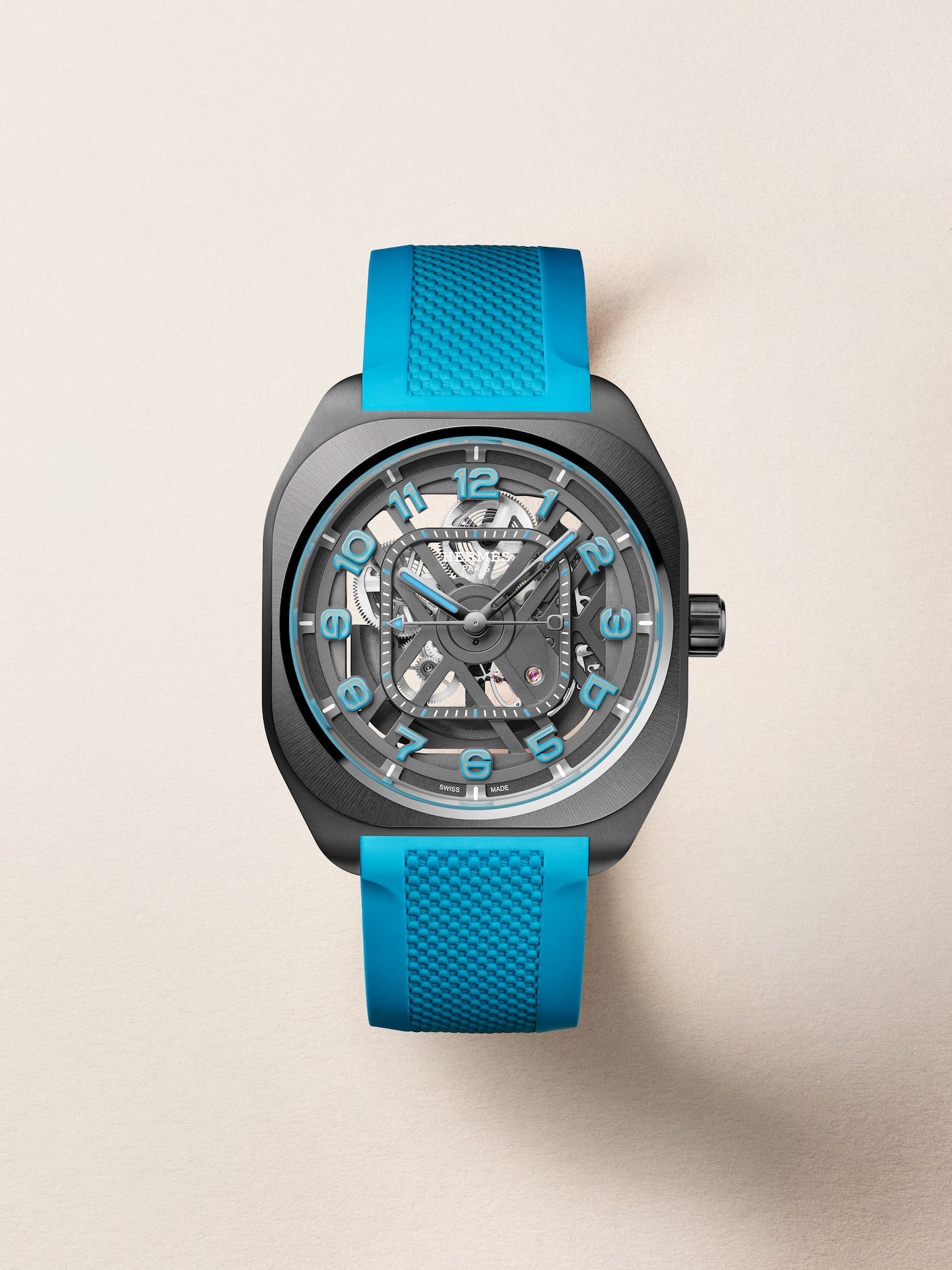
- Hermès H08 Squelette blue version with a 39 mm cushion-shaped case in black DLC-treated titanium and a satin-finished ceramic bezel with mirror-polished bevels, openworked black dial, applied Arabic numerals in blue Super-LumiNova®, and hands coated in black PVD with blue Super-LumiNova®.
A distinctive watchmaking approach
When Jean-Louis Dumas founded La Montre Hermès in Switzerland in 1978, the house did not simply enter a new field: it immediately set out to bring its own perspective to it.
“The first question, when you enter a field you haven’t practiced for centuries, is: what are we going to do there? How can we bring genuine expertise?” explains Laurent Dordet, CEO of La Montre Hermès.
-

- The establishment of La Montre Hermès in Switzerland in 1978, documented on this page of the Bulletin d’Informations (Europa Star).
- ©Archives Europa Star
The answer lay in a dual approach: relying on the house’s long-standing watchmaking partners – the relationships between the Hermès family and certain manufactures stretching back more than a century – while gradually developing its own technical expertise.

“From the outset, the ambition was clear: to progressively reach the technical standards of haute horlogerie, even if that meant taking decades. But also to assert a creative difference, because we are not watchmakers by origin. That has shaped a style, a distinctive way of approaching time.” This philosophy is marked by a certain lightness, a touch of whimsy, and occasionally a playful sidestep tinged with humour – a spirit that would notably emerge in the unconventional complications introduced by the house in the 2010s.
Hermès H08, a firmly established line
Launched five years ago, the H08 quickly found its place within this universe. Conceived as a contemporary and sporty watch, it plays with contrasts of materials, hybrid forms and interchangeable straps.
“The Hermès H08 embodies the contemporary, everyday spirit of the Hermès man,” recalls Laurent Dordet. “A recognisable silhouette, a play of materials and straps: today the line is firmly established.” With the skeleton version, Hermès now pushes this visual architecture even further.
Skeletonisation as graphic language
For Philippe Delhotal, Creative Director of La Montre Hermès, this new piece is not merely a technical exercise in style. “With this watch, you dive into the very heart of the mechanism. But it is less about demonstrating watchmaking performance than expressing a graphic language. We worked with space and emptiness.”
-

- The grey version of the Hermès H08 Squelette.
The openworked dial reveals the movement like an architectural stage set – at least that is what inspired the artistic director: “When you walk through a city and look at buildings, you sometimes glimpse their metal frameworks. We wanted to capture that idea of structure. The skeleton evokes architecture.”
The movement bridges thus form a geometric framework that echoes the cushion shape of the case. The applied Arabic numerals, filled with Super-LumiNova, appear to float above the mechanism. Two main versions are offered: one with blue accents, the other more monochrome in shades of grey.
A technical challenge in titanium
Behind this apparent lightness lies a considerable feat of engineering. The movement was developed with Vaucher Manufacture Fleurier, Hermès’ long-standing strategic partner, in which it holds a 25% stake.
-

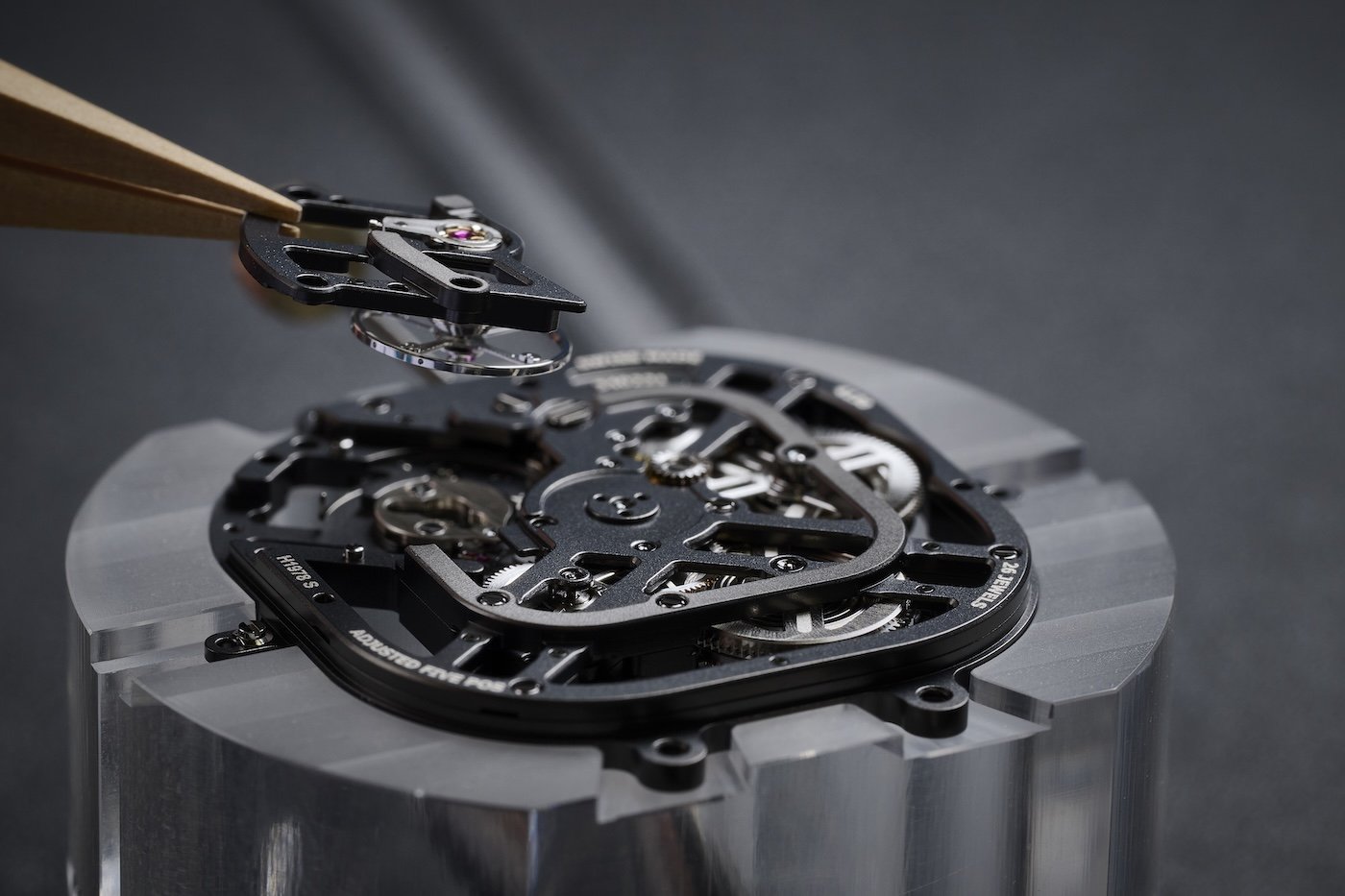
- Automatic self-winding Hermès H1978S movement, developed in collaboration with Vaucher Manufacture Fleurier: 27 mm in diameter, 4.165 mm thick, 168 components, 26 jewels, 28,800 vibrations per hour (4 Hz). Power reserve of approximately 60 hours.
“It took 12 months to develop this movement. All its functions have been certified for a 10-year lifespan, allowing us to offer an 8-year warranty,” reveals Stéphane Oes, Development Director at Vaucher Manufacture Fleurier. “The challenge was to reconcile an extremely openworked design with the requirements of strength and reliability.” Each component was designed using 3D simulations to verify the rigidity of the whole when subjected to mechanical stresses and everyday shocks.

To meet these requirements, the engineers chose a material rarely used for movements: titanium. “Titanium provides both lightness and strength, which perfectly matches the sporty spirit of the Hermès H08. But it is much more difficult to decorate than steel or brass.”
The movement also features a non-circular oscillating weight, designed on two levels to optimise the efficiency of automatic winding while integrating seamlessly into the visual architecture of the calibre.
The H1978S calibre
The Hermès H08 Squelette is powered by the H1978S calibre, which beats at 4 Hz (28,800 vibrations per hour) and offers a power reserve of around 60 hours.

Composed of 168 components and 26 jewels, it retains a slim architecture (4.165 mm thick) while ensuring robustness and precision. Housed in a 39 mm titanium case treated with black DLC and topped with a satin-finished ceramic bezel, it remains faithful to the DNA of the line: a sporty yet elegant watch, water-resistant to 10 bar and equipped with a screw-down crown. Rubber straps – Zanzibar Blue, black, dune, medium green or abyss blue – complete this technical and contemporary aesthetic.
An ancient tradition
Although skeletonisation may appear very modern, it actually belongs to a long watchmaking tradition. The first skeleton watches appeared in the mid-18th century, around the 1760s, when French and English watchmakers began deliberately openworking plates and bridges to reveal the mechanics within. In France, André-Charles Caron, a Parisian watchmaker and father of the playwright Beaumarchais, is often cited among the pioneers of this decorative approach.

With the Hermès H08 Squelette, Hermès continues the patient construction of its watchmaking identity, begun nearly half a century ago. “Our ambition remains the same as in 1978,” concludes Laurent Dordet. “To develop movements that are technically legitimate, while also expressing a creative sensibility that is uniquely Hermès.”

Priced at around 20,000 euros, the Hermès H08 Squelette marks a new stage in the evolution of the line – and confirms the house’s ability to transform mechanics into a true object of watch design.


