


 Español
 Français
 Pусский
 繁體中文
繁體中文 简体中文
简体中文 Select another language


astery of ultra-thin watchmaking has long been part of Vacheron Constantin’s DNA. From its earliest pocket watches, the Manufacture pushed the boundaries of miniaturisation. In wristwatches, a defining milestone came in 1955, during its bicentenary, with the calibre 1003. Measuring just 1.64 mm thick, this hand-wound movement became an absolute benchmark—an engineering tour de force whose influence would resonate for decades.
As Morgan Maillard, Style & Heritage Expert at Vacheron Constantin, explains, “creating an ultra-thin movement - especially in gold and with automatic winding - entails a level of complexity comparable, in my view, to that of a tourbillon.” Far from being an exercise in simplification, ultra-thin design represents an extreme concentration of expertise.
Thirteen years later, in 1968, the Maison reached another milestone with the automatic calibre 1120, just 2.45 mm thick. This movement - famously powering the 222 in 1977 - became a technical cornerstone. It has endured across generations, evolving and adapting, and remains to this day a key foundation, notably for perpetual calendar models.
At the height of the quartz crisis, this ultra-thin architecture proved decisive: it allowed the Maison to maintain a mechanical offering that was relevant, elegant, and distinctive. “The 1120 truly propelled us forward,” notes Morgan Maillard. Half a century on, Vacheron Constantin’s pursuit of slimness enters a new phase.

The calibre 2550
With the calibre 2550, Vacheron Constantin is not seeking to replace an icon within its movement portfolio, but to extend this lineage with intelligence and intent. The aim is not to be “thinner for the sake of thinness,” but to meet contemporary expectations - those of today’s clients: autonomy, robustness, and reliability.
At just 2.4 mm thick - slightly slimmer than the 1120 - the new movement nonetheless doubles the power reserve to 80 hours. A remarkable feat in this category, made possible by a fully re-engineered architecture.
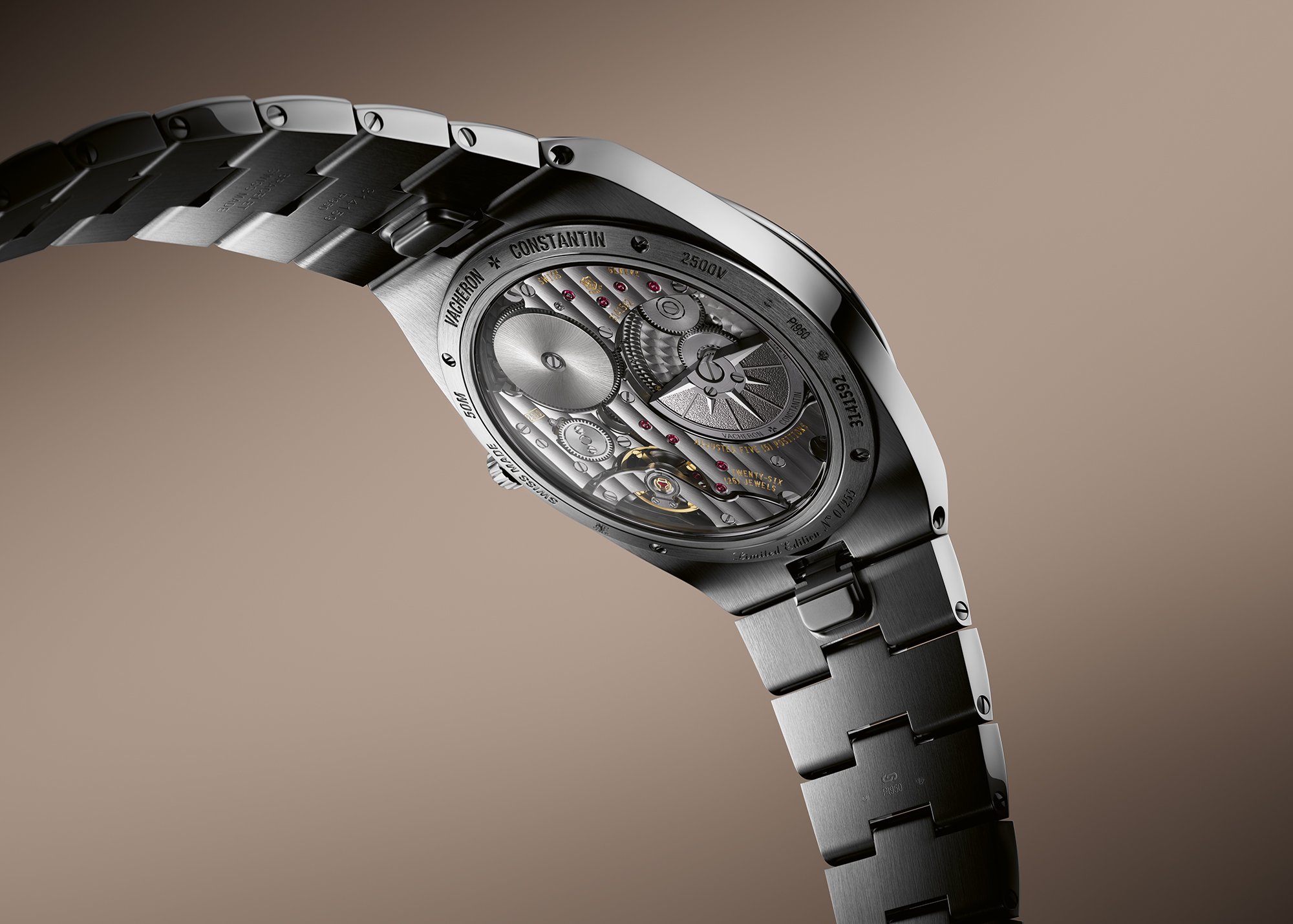
The calibre 2550 is built around three major innovations, starting with a platinum micro-rotor - the first of its kind at Vacheron Constantin - whose density optimises winding efficiency. Two superimposed barrels rotate on a single axis fixed to the barrel bridge. Their series configuration - stacked in an inverted orientation - allowed one barrel drum to be eliminated, contributing significantly to the movement’s slimness. As winding torque is transmitted directly to the upper barrel, while energy is delivered from the lower barrel to the output pinion, the ratchet wheel could also be dispensed with.
Despite their stacked layout, the barrels operate in series, coupled via their respective arbors. This configuration ensures highly stable torque and, in turn, excellent chronometric stability. A compact gear train, arranged on a single plane, has also been redesigned to fit within this constrained space. Certain wheels are mounted on ceramic micro-bearings, enhancing both smoothness and durability.
Morgan Maillard underscores this holistic approach: “We removed components and rethought the entire structure to optimise energy distribution and guarantee a genuine 80-hour power reserve.” A pragmatic philosophy, far removed from any race for records.
A different philosophy
Unlike some technical showpieces, the calibre 2550 is not conceived as an end in itself. It is part of a long-term vision. “When we launch a movement, we don’t yet know all the variations that will stem from it,” explains Morgan Maillard. “What matters most is that it opens up possibilities - it must serve as a solid base for the next 10, 20 or even 30 years.”
This philosophy is reflected in the technical choices. The 3 Hz frequency, for instance, meets the Geneva Seal’s requirements in terms of chronometry and reliability. Testing ensures accuracy within less than one minute over seven day - performance aligned with real-world use. Here, ultra-thin becomes a platform: designed to evolve, to host future complications, and to adapt across collections.
Sporty elegance in platinum
The new calibre makes its debut within the Overseas collection, in a limited edition of 255 pieces. With a diameter of 39.5 mm and a total thickness of 7.35 mm, this reference becomes the thinnest Overseas ever produced. The choice of 950 platinum for the case - a first for the collection - echoes the platinum micro-rotor within.
The alloy, enriched with copper and gallium, undergoes heat treatment that makes it 2.7 times more resistant than conventional platinum. This is no trivial detail, as “the case must withstand all stresses within such a constrained volume,” notes Morgan Maillard. Ultra-thin construction imposes structural demands that only a sufficiently robust material can meet.
Aesthetically, the watch opts for understated elegance. The sunburst satin-finished salmon dial, paired with platinum, subtly references historical models while asserting a discreet modernity. The 30.6 mm movement nearly fills the caseback, offering a striking view of its architecture.

The record may lie elsewhere
While the calibre 2550 opens a new chapter, it does not close the previous ones. The 1120 remains in use, notably as a base for complicated timepieces. More broadly, this development aligns with the Maison’s enduring motto: “Do better if possible, and that is always possible.” A constant invitation to explore, refine, and push boundaries—not for performance alone, but to enrich the watchmaking experience.
With the Overseas Automatic Ultra-Thin, Vacheron Constantin demonstrates a form of watchmaking that seeks not merely to impress, but to endure. During the celebrations marking its 270th anniversary in 2025 - a year of record-breaking achievements - CEO Laurent Perves emphasised that the priority was not to go “ever further,” but to undertake deep, meaningful work on movements, developing contemporary and sustainable foundations for decades to come.
The calibre 2550 embodies this vision perfectly. Not a record-chasing exercise, but a coherent, durable solution. Like its predecessors, its lifespan will likely be measured not in years, but in decades - perhaps even centuries. And that may well be its true record: longevity.


