
 Español
 Français
 Pусский
 繁體中文
繁體中文 简体中文
简体中文 Select another language


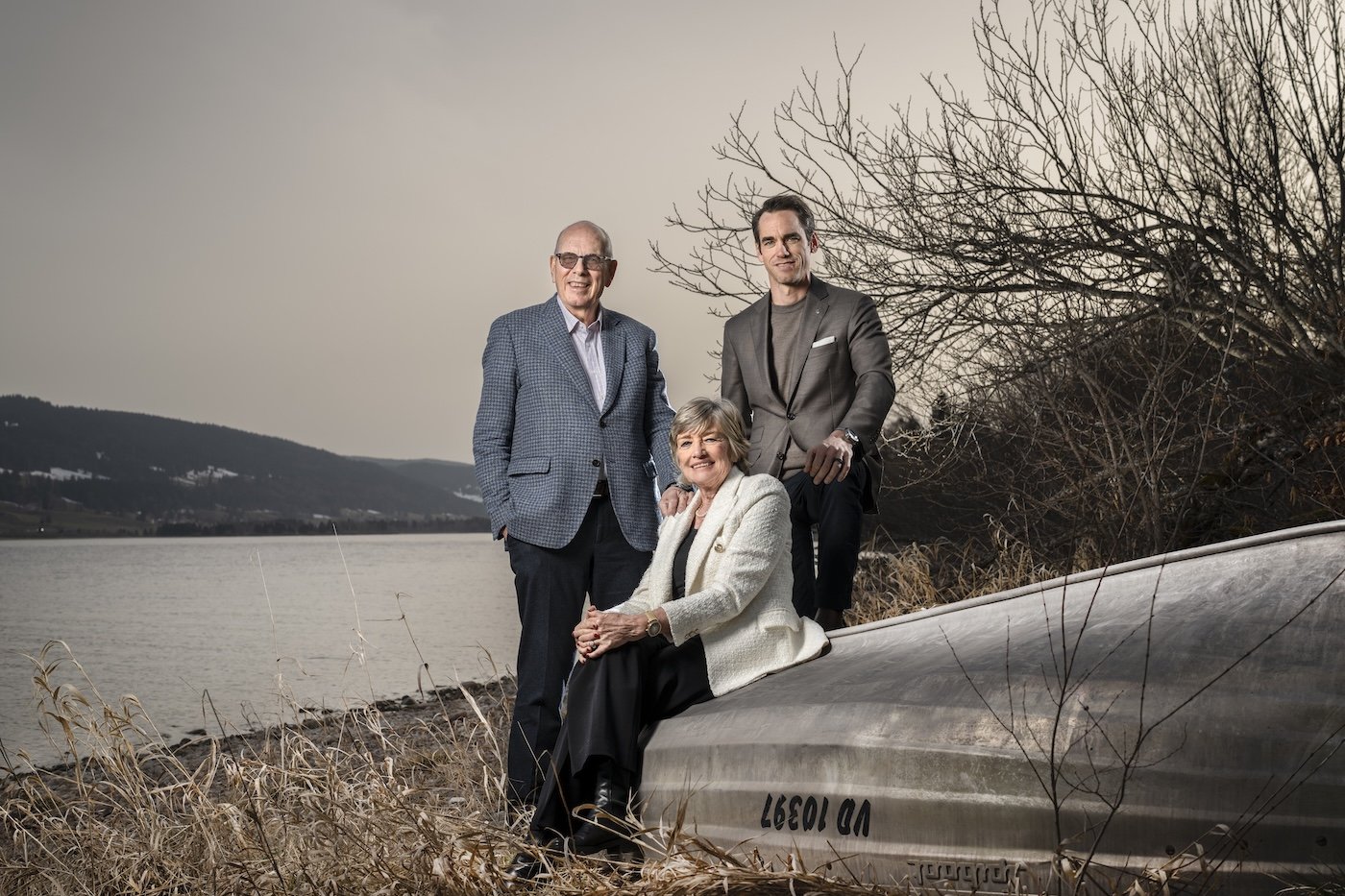
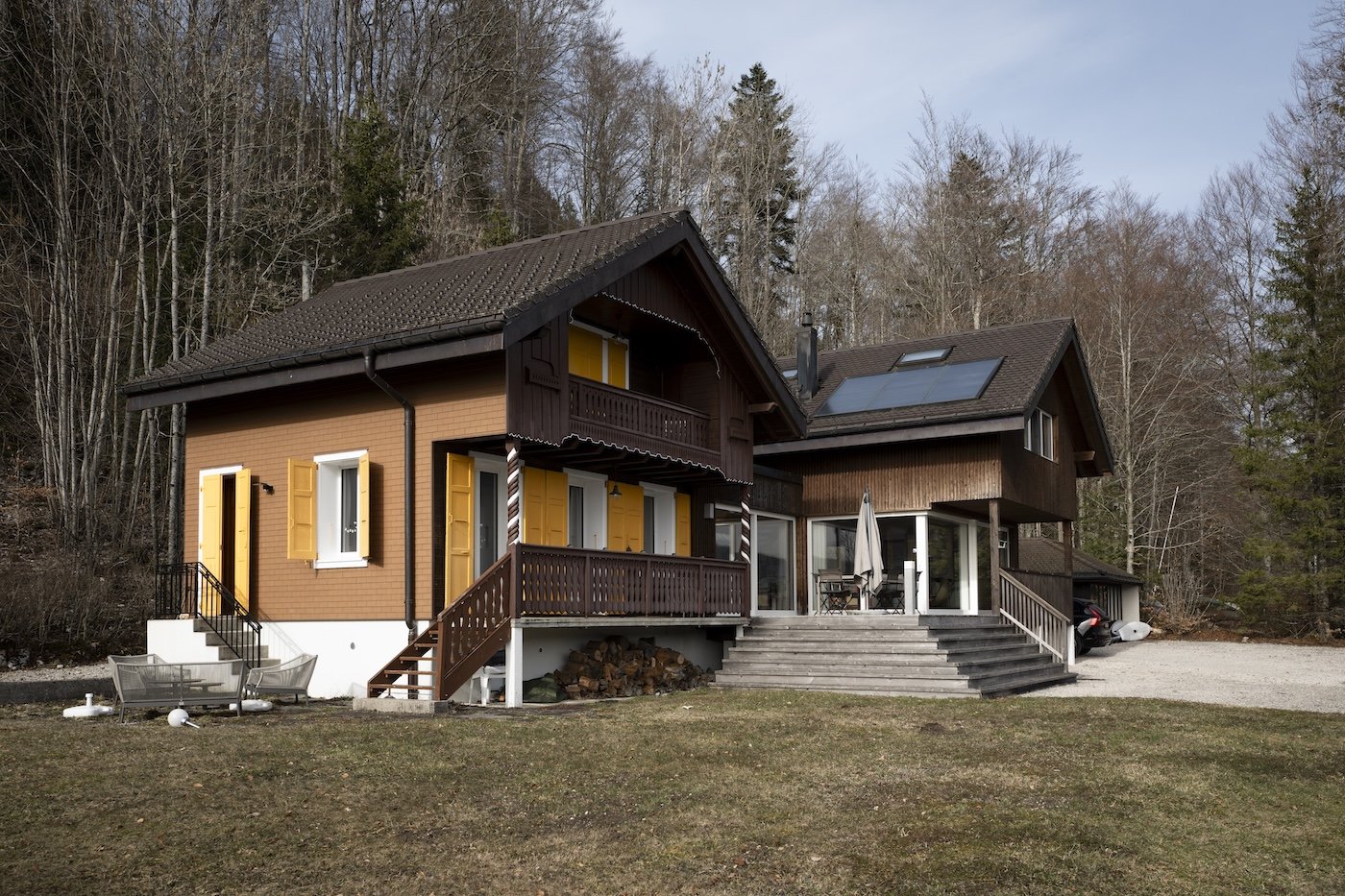
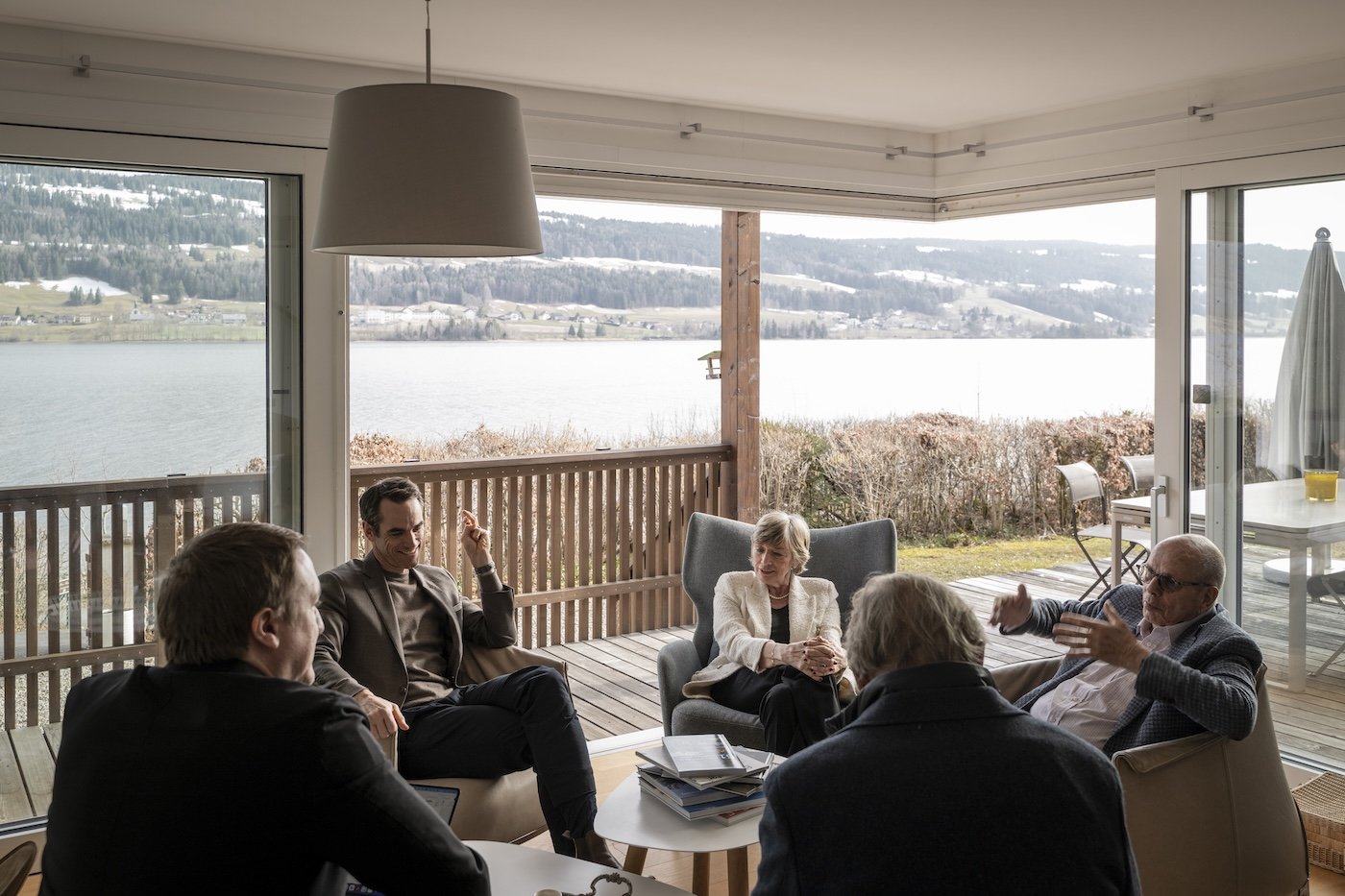
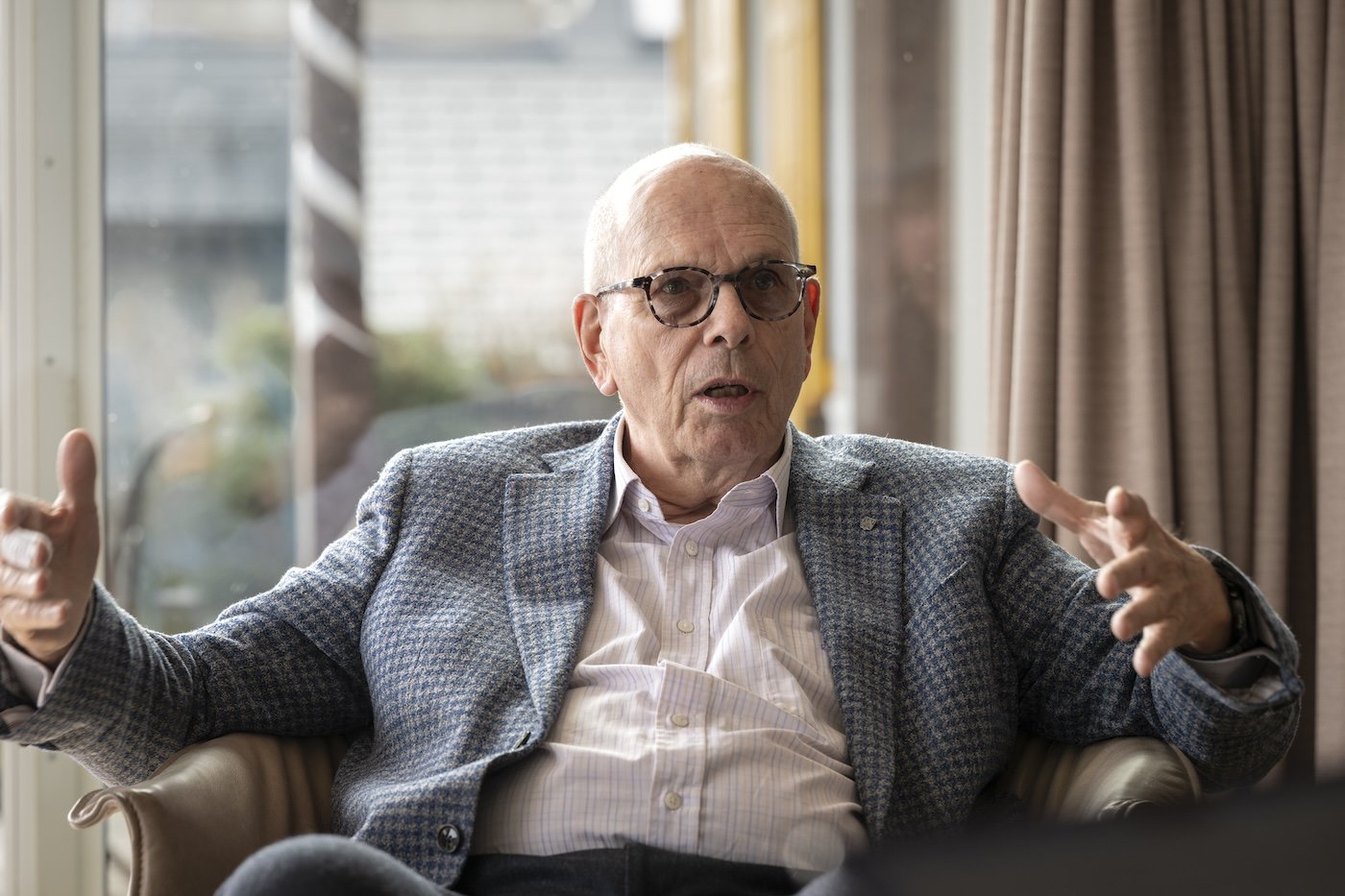
n these early days of March, we were welcomed by Georges-Henri Meylan, his wife Pascaline and son Edouard by Lac de Joux, at the chalet built by Georges-Henri’s great-aunt, then extended by and for later generations (children’s toys were scattered around the living room).
Georges-Henri Meylan steered Audemars Piguet from 1987 until 2008, during which time Pascaline was a constant and supportive presence. Edouard is at the head of Moser & Cie., brilliantly revived under the family’s stewardship. Unable to join us that day were the couple’s two other children: Léonore and Bertrand (stuck in Dubai, where he lives, due to the geopolitical situation). Both are also co-owners of the companies held by MELB. Bertrand is CEO of MELB Luxe Subsidiaries (i.e. the subsidiaries MELB Asia, MELB China and MEB Americas), in charge of the group’s distribution.

The MELB holding company? Short for ‘Meylan-Edouard-Léonore-Bertrand’. Its portfolio includes H. Moser & Cie and Hautlence, as well as a 50% stake in Precision Engineering, a specialist in the manufacture of escapement components. With the possibility of more to come, who knows.
True to the concept of our feature, which sees several generations interacting on either side of the table (interviewers and interviewees), the discussion naturally begins with genealogy....
Europa Star: The Meylans are prominent among the extensive families who have left their mark on Vallée de Joux and its remarkable history.
Georges-Henri Meylan: Yes, we go back quite a way! [laughs] As far as we know, the Le Lieu Meylans - as distinct from the Le Chenit Meylans, Le Lieu and Le Chenit being two municipalities in Vallée de Joux - passed through here in around 1370 but properly settled a century and a half later.
With the Association pour l’Histoire et la Généalogie des Meylan, we’re building a family tree that will go on view at the local museum. We’ve reached the early 1700s and already have a 35-metre roll of paper, and we have enough material to go back as far as 1500.
Are there any watchmakers in this family tree? Frankly, we’d be surprised if there weren’t!
Georges-Henri Meylan: We’re not looking for that kind of detail at the moment. We’re focusing on the origins, although having said that, there is one great watchmaker among our ancestors, Charles-Henri Meylan (1842-1916). He was the most famous of the Meylans in the 1800s, especially in the United States where he made some superb watches. I’d say I’m the biggest collector of watches by Charles-Henri Meylan. They’ll go on show at a retrospective in May, at Espace Horloger in the Vallée de Joux.
You actually own the rights to the C.H. Meylan name.
Georges-Henri Meylan: It was always my dream, and that of my family, to revive the Charles-Henri Meylan name, long before H. Moser & Cie., in 2000, and MELB Holding was formed with that in mind, but for various reasons this hasn’t yet been possible. We still have to uncover sufficient detail to establish precisely how we are related. The research we’re conducting with the Association could shed more light on that.
“We’re building a family tree with the Association pour l’Histoire et la Généalogie des Meylan. We’ve got as far as the early 1700s and already have a 35-metre roll of paper.”
Whoever your ancestors are, there’s no getting away from watchmaking in the valley.
Georges-Henri Meylan: That’s true, there’s no escaping it, although my parents were in the hotel trade. They ran Hôtel du Lion d’Or, a hotel and restaurant in Le Sentier. When my father passed away, my mother and sister took over for a while, then it was sold. But there were some uncles and other relatives working in watchmaking at that time, so there was already a connection. I knew early on that the hospitality business wasn’t for me. I wanted to be a mechanical engineer.
Microengineering?
Georges-Henri Meylan: No, this was before microengineering courses existed. Plus I was interested in cars. I studied at EPUL, Ecole Polytechnique de l’Université de Lausanne, the forerunner to today’s EPFL [Ecole Polytechnique Fédérale de Lausanne]. During the holidays, I’d earn money by working at Jaeger-LeCoultre. I got on well with the director, who was an EPUL alumnus. After graduating, I got a job there and stayed for a dozen or so years.
What year was that and what was the situation like for the Swiss watch industry?
Georges-Henri Meylan: I started at Jaeger-LeCoultre in 1971. This was just before quartz and the beginning of some long and extremely difficult years. Companies cut back working hours, diversified, tried making things other than watches: measuring instruments, writing instruments, descaling equipment, basically any kind of small precision mechanism.
And you stayed in the industry, despite all the difficulties?
Georges-Henri Meylan: A lot of those who jumped ship went on to pay the price. Thankfully, plenty of companies in the Vallée stayed in mechanics. I worked in England during part of this time, to perfect my English, and after Jaeger-LeCoultre spent a couple of years with Cartier, in Fribourg. Then one day I got into conversation with Georges Golay, who was at the head of Audemars Piguet, and he asked if I’d be interested in going back to the Vallée and taking charge of industrial management.
Back then, Audemars Piguet was still a relatively small company, turning over in the region of CHF 70 million and producing around 5,000 watches a year, with little in the way of marketing and no real industrial management in the modern sense. A lot of things were resting on the shoulders of a few key individuals. My brief was clear: structure the industrial base, support growth, professionalise the organisational structure and evolve a business that was still operating with largely artisanal methods.
Virtually no complete movements were made in-house. Parts were bought in then assembled, cased and finished. The majority of movements were purchased from Jaeger-LeCoultre. The company had yet to make the transition towards industrial autonomy. My role was to bring more industrial capacity in-house.
That was in 1987. You spent less than a year working with Georges Golay, the visionary behind the Royal Oak launch, as he unexpectedly passed away.
Georges-Henri Meylan: That’s right. Georges Golay wasn’t ill but he died suddenly, following a small operation. Stephen Urquhart and I were appointed co-CEOs of Audemars Piguet. We worked together for a decade then Stephen left and I stayed on as CEO for another ten years or so.
-

- Following the sudden death of Audemars Piguet’s legendary director Georges Golay in 1987, Georges-Henri Meylan and Stephen Urquhart took over as co-CEOs of Audemars Piguet, as detailed in this article from Europa Star at the time.
- ©Archives Europa Star
-

- Following Stephen Urquhart’s departure in 1997, George-Henri Meylan remained at the helm of Audemars Piguet on his own for more than another decade.
- ©Archives Europa Star
You joined Audemars Piguet in 1987. When you left in late 2008 it was a different world and the company was enjoying exponential growth.
Georges-Henri Meylan: They were interesting times, with the revival of the mechanical watch, the rise of Swiss watchmaking globally and market expansion. Arnold Schwarzenegger wore the Royal Oak. It used to be that when a watch left Le Brassus, we’d done our job. Later, we had to get it all the way to the customer’s wrist.
We opened subsidiaries in different countries. There weren’t many boutiques. As I recall there was one in Geneva, possibly one in Paris, not many more. Then it was a matter of structuring this global growth, integrating bigger margins, knowing all the way to the end customer. It was a natural evolution and not just at Audemars Piguet. Growth was steady. There were a couple of spurts but no sudden explosion. Plus there were some major advertising campaigns around this time, mainly for the Royal Oak which became the driving force.
This is also when the large luxury groups were emerging.
Georges-Henri Meylan: Yes, but whereas other established names in the valley were taken over by Richemont, Swatch Group or other groups, Audemars Piguet remained family-owned and independent. This is an essential characteristic of its identity. Today you can see the contrast with companies that were subsumed into groups. Audemars Piguet has always followed a different path, while consolidating its industrial and financial base.

-

- This article, published in 1998 in Europa Star, outlines Audemars Piguet’s strategy for the new millennium, at a time when the company was led by Georges-Henri Meylan. It notes, in particular, that the Le Brassus-based brand then employed 250 staff, producing 14,500 watches annually and generating a turnover of 120 million francs, representing an annual growth rate of 15%. This strategy emphasised maintaining Audemars Piguet’s independence at a time when the watchmaking world was witnessing numerous takeovers and integrations within luxury groups. At that time, Audemars Piguet still held a 40% stake in Jaeger-LeCoultre, which was sold to Richemont in 2000. This interview reveals the early signs of the integration of production and distribution that would follow over the next two decades.
- ©Archives Europa Star
Was the sale of Jaeger-LeCoultre, IWC and A. Lange & Söhne (LMH group) to Richemont an important juncture for Audemars Piguet?
Georges-Henri Meylan: Yes. In 2000 LMH sold its watch brands to Richemont for CHF 3.08 billion. Audemars Piguet held a 40% stake in Jaeger-LeCoultre and this valuation increased substantially, which generated significant financial resources. Also, a strategic contractual agreement guaranteed a ten-year supply of movements and this gave Audemars Piguet time to massively invest in its future development, particularly with regard to movements.
The sale of Jaeger-LeCoultre propelled Audemars Piguet’s growth. Since 1992 the brand had also held a majority stake in Renaud et Papi, which produced complicated movements then forged ties with Richard Mille.
Georges-Henri Meylan: Richard Mille was a client of Renaud et Papi. He was working at Mauboussin. But this initial phase didn’t last long. Later, we crossed paths again, this time with Dominique Guenat, his business partner, and we agreed it was a shame not to work together. Renaud et Papi made the first movements for Richard Mille when they launched.
Pascaline, we know you supported Georges-Henri throughout these years.
Pascaline Meylan: We never really worked together but I’d say I was very much involved. I was fortunate to be well integrated at Audemars Piguet. I travelled extensively and met many clients. There were multiple occasions when it was preferable that we came as a couple. It’s become quite rare in in the industry today but we did travel together on a regular basis, and this counted for a lot in customer relations.
These relations have carried on to the next generation, as Edouard and Bertrand work with distributors whom we knew then, in Singapore in particular. Some turned their back on us, but many have remained loyal during all these years.
-

- A leap into the future: the Streamliner Pump, created in collaboration with Reebok, has just been unveiled at Watches and Wonders by H. Moser & Cie, which has joined the big league with its first-ever stand in the central hall. Whilst Reebok is preparing the return of the Pump for 2026, H. Moser & Cie. has devised an unexpected solution: winding a mechanical movement using the famous orange button. A single press provides over an hour of power reserve.

Edouard, you were born in 1976. What legacy did you take from these decades?
Edouard Meylan: My earliest memories are of Jaeger-LeCoultre. I can still picture myself, barely tall enough to see over the table, at the open days. They organised fun things for the families. I’m convinced this plants seeds for a lot of future careers.
You also went to EPFL.
Edouard Meylan: That’s right, to study microtechnology. You can see how things had changed between my father’s generation and mine. [smiles] Why microtechnology? Because I wanted to open doors. I loved maths and physics, and preferred more general subjects to specialised ones. Microtechnology touched on IT, electrical engineering, electronics and production management, which is what I wanted. A broad view.
My first job after graduating was to develop a prosthetic for a paraplegic recovery unit. I was the first person to work on it, with plans to do a PhD, but soon realised it wasn’t for me. It would take seven years of research before we could even begin industrialisation, and I wanted to get to the industrialisation stage much faster.
You were eager to travel too, is that right?
Edouard Meylan: That’s right. I completed my studies in 2000, worked as a consultant for three years, then in 2004 set off for Malaysia, where I stayed for almost three years. That’s when I understood that I still wanted a global vision of business. So I enrolled at Wharton School in the United States, leaving in 2008 with an MBA.
Your next “adventure” would be Celsius telephones. That was quite a gamble.
Edouard Meylan: Now that I had an MBA, finance was one option but I missed the product side of business. I almost joined Chanel but in the end got together with some friends to launch Celsius. Mechanical mobile phones! Honestly! People kept telling me I was mad. This was in 2008, in the midst of the financial crisis. We thought we could sell very expensive items, along the lines of what Richard Mille was doing, except we underestimated the investment it would take in technology and development. And probably the extent to which people would actually buy into the product. In hindsight, we were too early for the hybrid or connected watch and too late to surf the Vertu wave. The iPhone had launched and was changing expectations. Even so, Celsius taught me a lot about content creation, brand message, business model and managing cashflow. It was a genuine learning experience.
-

- Before joining MELB Holding, Edouard Meylan cut his teeth as an entrepreneur with Celsius, a high-end mechanical phone, which was featured here in Europa Star in 2010.
- ©Archives Europa Star


Did Celsius end for you when Moser began?
Edouard Meylan: Not exactly. MELB Holding acquired Hautlence in the spring of 2012 when I was still at Celsius. I left Celsius in late 2012 or early 2013 and the company carried on for a while. Hautlence was the foundation.
Bertrand, my brother, had worked for Audemars Piguet in different markets before leaving for Hong Kong. After that, he decided to set up on his own. We created the first MELB distribution structure in Hong Kong, mainly for Hautlence.
Georges-Henri Meylan: It all happened very quickly, as MELB acquired Hautlence in spring 2012 and H. Moser & Cie. shortly after, in October 2012. Already, with Hautlence the idea was to set up a small structure, a family holding company, MELB, almost like a private equity fund, that would acquire a few brands, create synergies and try to develop them together.
-

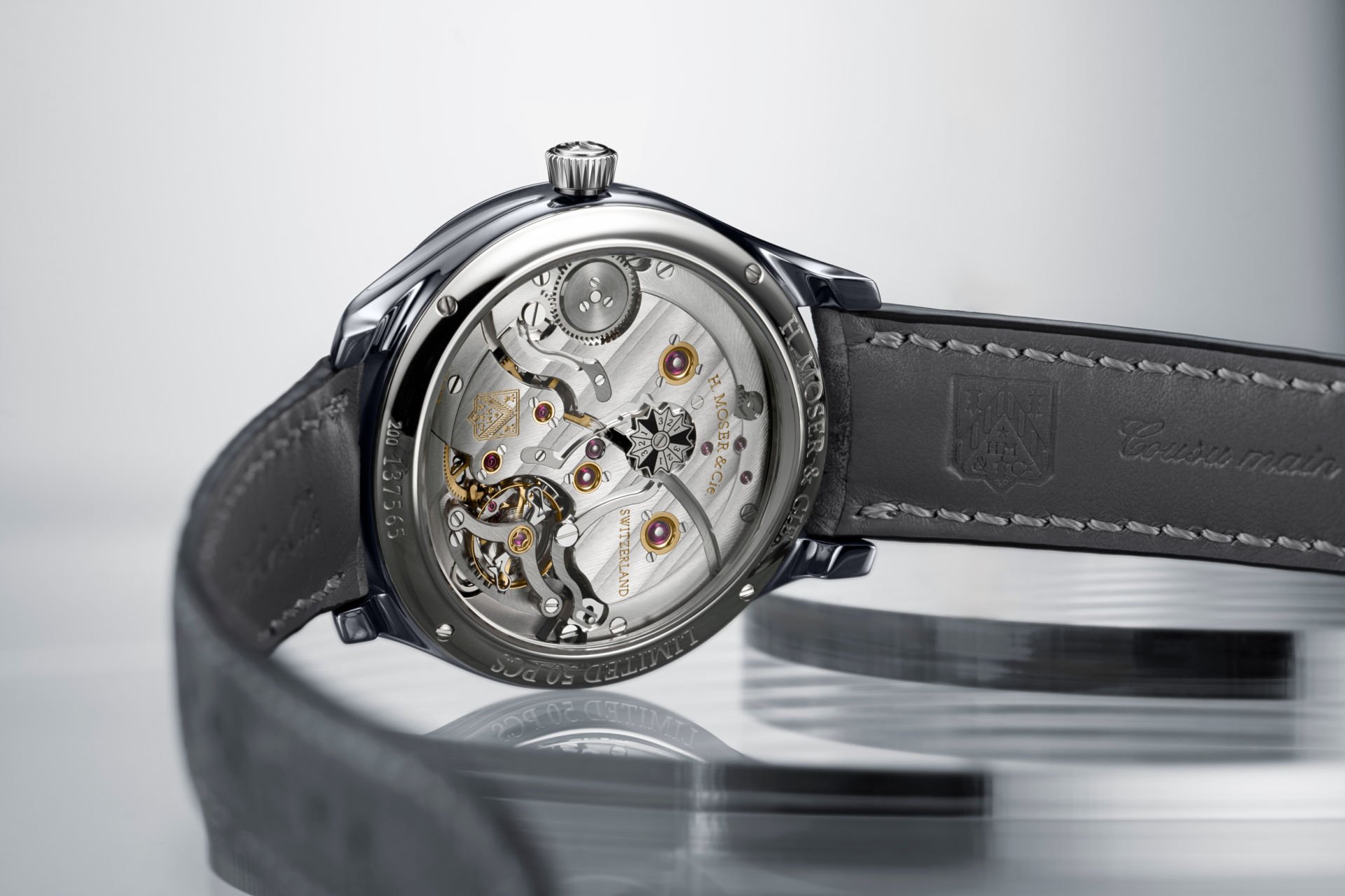
- Endeavour Minute Repeater Cylindrical Tourbillon Skeleton: a fully skeletonised minute repeater, with its mechanism on full display, combined with a flying tourbillon fitted with a cylindrical balance spring. Two pinnacles of traditional watchmaking brought together in a single timepiece with a resolutely contemporary design, housed within a 40 mm diameter titanium case. At 2 o’clock, a small domed dial, featuring H. Moser & Cie.’s famous smoked Funky Blue, acts as a secret signature.

What state was H. Moser & Cie. in when you bought it?
Edouard Meylan: It was extremely complicated. Around five million turnover for a loss of ten million. About 70 people. They were selling watches for less than they cost to produce. Once we started analysing the accounts, we saw that gross margin was negative on many of the products. We really liked the product and thought we could do something with it, but this would mean completely rethinking cost price.
We took over the company on the understanding that we would acquire the business, the products and the teams but not the bank debt. We did, however, decide to pay money owed to suppliers. It took years to pay some but it was a matter of respecting the ecosystem and carrying on working together.
Georges-Henri Meylan: : As a family we said, OK, let’s do it, but let’s do it properly. Not just to save someone’s face. We had to own the brand and so we negotiated: we’ll cover part of the debt, we’ll put money in but we want 51% of Moser plus a buyout option if it works. Which is what we did later.
What exactly drew you to the brand?
Edouard Meylan: There was a particular story to tell about the Moser family, Russia, the entrepreneurial spirit. There was a strong distribution network, including Bucherer. And there were the products: the perpetual calendar, the double hairspring, the fumé dials… real industrial expertise. We had all the ingredients, things that even some major brands would love to have. The question was, could we find the right recipe?
And how was this “recipe” concocted?
Edouard Meylan: We were up against some really creative independents, the likes of MB&F and Urwerk, but with a different product. We were also competing with the likes of Patek Philippe and other established names. We asked ourselves, in an industry that already has 450 brands, what can H. Moser & Cie. bring? We had to find a unique balance between modern and traditional watchmaking, both for the product and communication.
The biggest challenge independents faced was that they were addressing a small group of collectors who were always on the lookout for the next big thing. For a brand to exist, every year it had to release something truly exceptional. At Moser, we knew we either had to go against the grain or be forced to revolutionise the industry year after year, which makes no sense. The fumé dials, the minimalism, the focus on the very essence of the watch, the provocations: all this opened a tiny window onto a different world, with the hope that people would go on to discover everything else the brand had to offer.
-

- The Swiss Alp Watch is one of those bold concept models that propelled H. Moser & Cie into the limelight during the second half of the 2010s. Here is an archive image from Europa Star dating from 2019. Since then, the brand – which has grown tenfold in size – has toned down some of its more provocative features, whilst retaining a resolutely experimental character.
- ©Archives Europa Star
Europa Star has written a lot about Moser’s guerilla marketing tactics. The brand had something of a reputation.
Edouard Meylan: All over the world, for years people were talking about the Swiss Alp Watch, the Swiss Mad Watch, the Swiss Icons Watch… and we still get asked about them! It worked because it was coherent. At first people thought we were clowning around, until they realised there was a real strategy and, more importantly, a serious product behind it all.
When we released the Genesis, with a QR code etched in the sapphire crystal, a 3D-printed pixellated titanium bezel and a press conference in the metaverse, it wasn’t just about being deliberately unconventional. We were exploring, looking at what was happening elsewhere, at other industries, other materials, other uses, and asking what could they bring to watchmaking. Now we’re working on smart materials, hybrid instruments for Alpine, for example, that don’t give the time but measure something else. We’ve incorporated ceramic, explored polymer-based composites and quartz fibre. There’s a lot going on behind the scenes.
-

- The purity of H. Moser & Cie.’s perpetual calendar, now available with both a tantalum case and dial on this Endeavour Perpetual Calendar Concept Tantalum model. Unconventional Haute Horlogerie for connoisseurs, in keeping with the brand’s motto.
Were you surprised by Moser’s success?
Edouard Meylan: Yes and no. This was a good time for independents. Things really took off in 2018 but prior to that, from 2013 until 2017, it was tough. We’d underestimated the problems at the outset and at times wondered if we could keep going. In 2014 we made a turnover of around nine million. This rose to around 13 million, after which we hit a glass ceiling. Every watch struggled to sell. We weren’t yet making volume sales at retailers. It felt as though we had to fight for every single unit.
For me, the lightbulb moment was the Funky Blue perpetual calendar. That’s when we realised we had to keep a strong product but approach it from a different angle. Next we released the first Concept watches with no logo, originally as a communication exercise to show how beautiful our dials were but we were so convinced by the result, we thought we should maybe make them for sale.
In our price segment, you can’t just be a “nice” watch. If someone’s going to spend CHF 25,000, they have to buy into the product. You have to polarise opinion. The more polarising we became, the more we sold. People are all or nothing. Either they love something or they hate it. But when they love it, they really, really love it.
Coherence has been the cornerstone of the brand. One of the biggest compliments I’ve received from a customer is when someone told me, “I don’t like this watch but I do like the fact you’ve made it.” At that moment, I knew we’d become a brand with an identity and its own way of doing things, not just a set of products.
“If someone is going to spend CHF 25,000 on a watch, they have to buy into the product. You have to polarise opinion. The more polarising we became, the more we sold.”
How have you managed growth?
Edouard Meylan: The biggest task to begin with was to develop a sound basis, meaning products we could make a margin on. To give an example, the perpetual calendar used to take 90 hours to assemble. Today it takes between 18 and a maximum 25 hours. Which changes everything. We’ve also developed movement families with a high level of component sharing. This makes us far more competitive.
Turning a company round sometimes involves difficult decisions. It’s never easy, because we work with people and have a responsibility towards them, but we have a responsibility towards the rest of the organisation, too. In hindsight, at Moser, we probably didn’t go as far as we should have to begin with. We should have reduced the workforce to 20 people, instead of which we went to 35, which was still 15 too many. We were paying them for some time and that cost us a lot. But this is something you sometimes have to do in order to rebuild for the long term.
Then there are the right investments, the right timing, the right products. The Streamliner gave us a huge boost. A lot of brands jumped on the trend for luxury sports watches à la Royal Oak or Nautilus, whereas we wanted to do something completely different, unique. And it paid off.
-

- The Streamliner: H. Moser & Cie’s take on the sporty-chic style. Now also available in 34 mm and 28 mm sizes.
And while all this was going on, you had to rethink distribution.
Edouard Meylan: Yes. Growth is never a straight line. After the Covid outbreak in March 2020, 90% of our points of sale closed. We decided we had to sell direct-to-consumer and wrote to our retailers explaining that, for the brand to survive, we reserved the right to sell 10% of production directly, with the assurance there would be no discounted prices. A fortnight later we had a web page and it wasn’t long before we’d sold a first tourbillon to a customer in the United States who’d never worn a Moser before.
It was a gamechanger. A watch sold directly to the end customer makes as much as three or four watches sold through certain traditional channels and the marginal cost is very low. No need to open a store in Ginza. Just a web page, a few emails and a FedEx shipment. It gave us the means for more marketing, to go to Watches and Wonders, to launch the partnership with Alpine, etc.
I always tell my team, margin is the key to business. If we want to finance development over five or ten years, invest in marketing, open a new production facility, we need money. Today we are debt-free and own a 100% stake. We financed growth on a solid basis and thanks to the luck we had during that amazing period for independent watchmaking.
“One of the biggest compliments I’ve received from a customer is when someone told me, ‘I don’t like this watch but I do like the fact you’ve made it.’ At that moment, I knew we’d become a brand with an identity and a way of doing things, not just a set of products.”
Hautlence is a symbol, stylistically speaking at least, of that “amazing period for independent watchmaking”. Are you aiming to reproduce Moser’s success with MELB’s other brand?
Edouard Meylan: Not exactly. It’s a different trajectory, almost the opposite problem, in fact. Unlike Moser, Hautlence has always been distinctive, architectural, contemporary. The challenge today is to introduce greater authenticity and legitimacy, to work on finishing - everything Moser brings - while remaining true to its reputation as a brand that challenges conventions. We want to keep this modern dimension but with a stronger element of tradition and expertise.
At one point we had to put Hautlence on hold somewhat, because Moser was stepping up pace and we only had limited means. When you have two horses and one of them is racing ahead, you put more on that one. Now we can pour more energy into Hautlence. Cédric [Cédric Joos, Hautlence’s brand manager, alongside founder and former CEO Guillaume Tetu who returns as chairman and advisor] has bags of energy and ideas. I’d rather someone have too many ideas that might need channelling than the opposite!
-

- The Kubera: Hautlence’s creative reinvention, featuring a new case, a new design, a new movement and a new positioning. The hour is displayed in a window. The minutes are indicated by a cursor travelling around the edge of the dial, guided by a rail concealed beneath the surface.
-

- The Sphere Series 4, embodying the very essence of Hautlence’s three-dimensional design. Rectangular titanium case, sand-coloured textured sphere, retrograde minutes. Hand-wound Calibre A82.

-

- A tribute to the futuristic imagination of the 1960s, when we dreamed of the future in black and white: the Hautlence Retrovision ’64, with its distinctive clapper and perforated grille.
Could you explain MELB Holding’s structure and are you planning any new acquisitions?
Georges-Henri Meylan: It’s a family holding company with five shareholders. There’s a bit of real estate, a few investments in the medical sector, but the main part is Meylan Luxury, which owns H. Moser & Cie., Hautlence and the distribution network. We have subsidiaries in Hong Kong, the United States and the Middle East. Bertrand manages a large part of distribution from Dubai.
As for possible acquisitions, we get fewer enquiries from brands than before. Now we’re more interested in suppliers. Precision Engineering is already a fabulous asset for balance springs. We need to stabilise and properly develop what we have before branching out. Any money we could invest [in acquisitions] is probably better spent on our own companies.

-

- A joint interview with Georges-Henri and Edouard Meylan, conducted ten years ago in 2015 in Europa Star, on the early days of MELB Holding. “Our model is the Swiss Confederation,” says Georges-Henri Meylan. “There’s a clear momentum building,” adds Edouard Meylan.
- ©Archives Europa Star
Edouard Meylan: Moser employs around 115-120 people and will probably reach 135 by year-end in Switzerland, plus around 15 people internationally. That’s close to 150 in total. And we’re investing. Our new production facility will open in two years, still in Schaffhausen, opposite the famous Rhine Falls.
Currently we lack the space to go further which limits how efficient we can be. The new facility will open for the 200th anniversary in 2028. Ultimately there’ll be around 200 people on-site. Plus we’ll be able to welcome customers and offer a setting that is completely aligned with the area’s industrial history. Watchmaking in Schaffhausen has always been closely tied to hydraulic power.
Night is falling over Lac de Joux. By the water’s edge, the photographer is beginning to lose patience.
We troop down to take a photo…