
 Español
 Français
 Pусский
 繁體中文
繁體中文 简体中文
简体中文 Select another language


e no longer speak of watches, but of works of art.” Founded in 1738, Jaquet Droz has long distinguished itself through its automata and artistic creations, once destined for the courts of Europe and Asia. But for Alain Delamuraz, who took the helm four years ago, the challenge lay in reinterpreting this legacy for the 21st century. “We are a 288-year-old start-up. What matters is not age, but mindset. If Pierre Jaquet-Droz were alive today, he would be pushing the limits of his era.”
The strategy is disarmingly simple: remove Jaquet Droz from conventional watchmaking comparisons. “I don’t want our pieces to be comparable. Sapphire tourbillons - others make them. But a dial combining paillons, enamel, three-dimensional damascening and sculpted mother-of-pearl becomes a work of art. And a work of art cannot be compared.”

Before joining Jaquet Droz, Alain Delamuraz had already led several brand repositionings, notably at Blancpain, where he championed clearly defined territories. “At Blancpain, we structured three pillars: diving with Fifty Fathoms and the Blancpain Ocean Commitment; gastronomy with Joël Robuchon, Leading Hotels of the World and Relais & Châteaux; and automotive mechanics with the Blancpain GT Series. This avoided internal competition within the Swatch Group.”
At Jaquet Droz, the approach is radically different - almost the reverse. With no collections and no boutiques, the brand’s territory is no longer defined by function but by ultra-personalised artistic expression, at the service of the client and virtually without limits - echoing the very origins of luxury.
The result: annual production now stands at just 50 to 100 pieces, often priced above CHF 400,000, with entry points around CHF 100,000.
The client as the third artist
In this new paradigm, each creation emerges from a three-way dialogue between artisan, artist and collector. “The third artist is the one who wears the watch,” says Alain Delamuraz.
Projects evolve through an ongoing creative exchange. Some are strikingly personal. A Middle Eastern collector requests a camel on his dial - yet its lips must be redesigned to match those of his own animal. A younger client seeks to integrate his Ferrari into an urban landscape. Others draw on deeper cultural references: a Chinese collector imagines a piece inspired by the Forbidden City. Each watch becomes a highly individual expression - at once cultural fragment and personal narrative.
-

- The Petite Heure Minute Jardin Japonais is a unique piece that brings to life a private collector’s vision of an ideal Japanese garden. A subtle layer of semi-translucent grey paint creates a striking sense of depth. The temple is composed of 25 appliqués - mostly crafted in sculpted and engraved mother-of-pearl - set against a dial also made of mother-of-pearl. A true goldsmith’s work, executed entirely by hand, to the nearest tenth of a millimetre.


“We can spend hours refining a project with a client, according to our philosophy of the unique - one more exchange, one more idea. We engrave, adjust, build the piece together. In a sense, we are rehumanising luxury.”
Each creation is accompanied by comprehensive documentation: a film, a publication retracing the creative process, and, crucially, the client’s direct involvement alongside the artisans. “In watchmaking, many transactions have become purely economic. We want to place the artist back at the centre. Few people would buy a painting without knowing the artist - why should it be different for a watch?”
Métiers d’art and automata
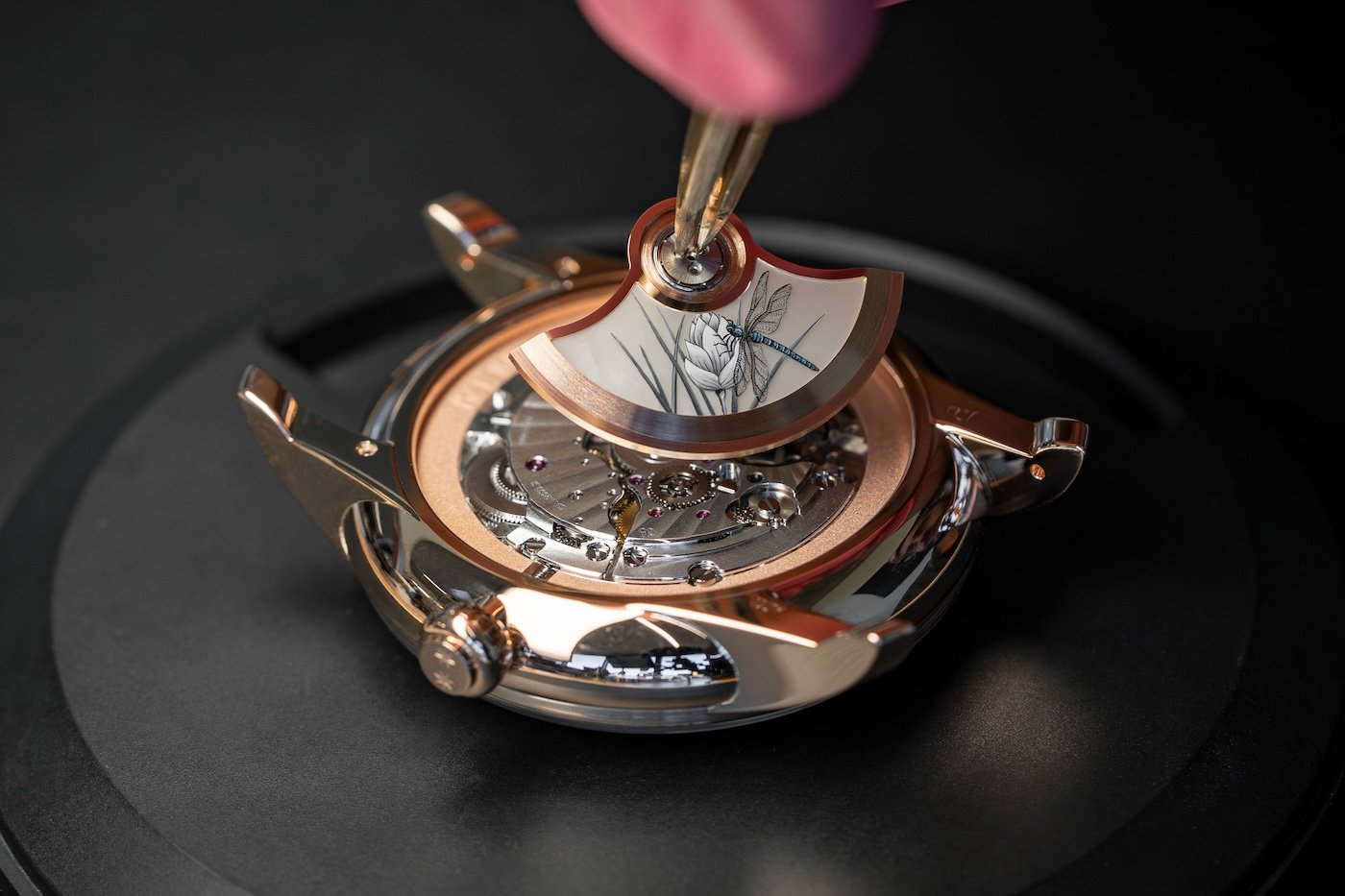
The artistic substance of these creations rests on two historic pillars of Jaquet Droz: métiers d’art and automata. The maison explores rare - and sometimes reinvented - techniques: revisited paillonné enamel, three-dimensional damascening combining metals of varying hardness, monobloc mother-of-pearl sculpture fused with gold, gold inlays in titanium, plique-à-jour compositions, and complex three-dimensional structures merging jewellery with micro-architecture.
-

- With its Joyful Inflatable Birds, Jaquet Droz ventures into the realm of Inflatable Art, where forms gain volume, soften into rounded silhouettes and embrace an almost playful dimension.

Some dials incorporate more than twenty-five applied elements. Technical virtuosity is omnipresent. “We now aim to avoid creating pieces that include neither métiers d’art nor automata,” Delamuraz notes. Increasingly - explaining why average prices have doubled in two years - the most sought-after creations combine both of Jaquet Droz’s historic specialities.
John Howe and the “Tour du Fantastique”
This artistic ambition is further embodied in a collaboration with John Howe, the renowned art director behind The Lord of the Rings. In Neuchâtel, the newly inaugurated “Tour du Fantastique” (Tower of Fantasy) - a former prison transformed into a hub for cultural and artistic imagination — houses the artist’s studio and stands as a symbol of this partnership.
-

- John Howe alongside Alain Delamuraz at the new “Tour du Fantastique” in Neuchâtel, where the artist - closely associated with Jaquet Droz - has established his studio.

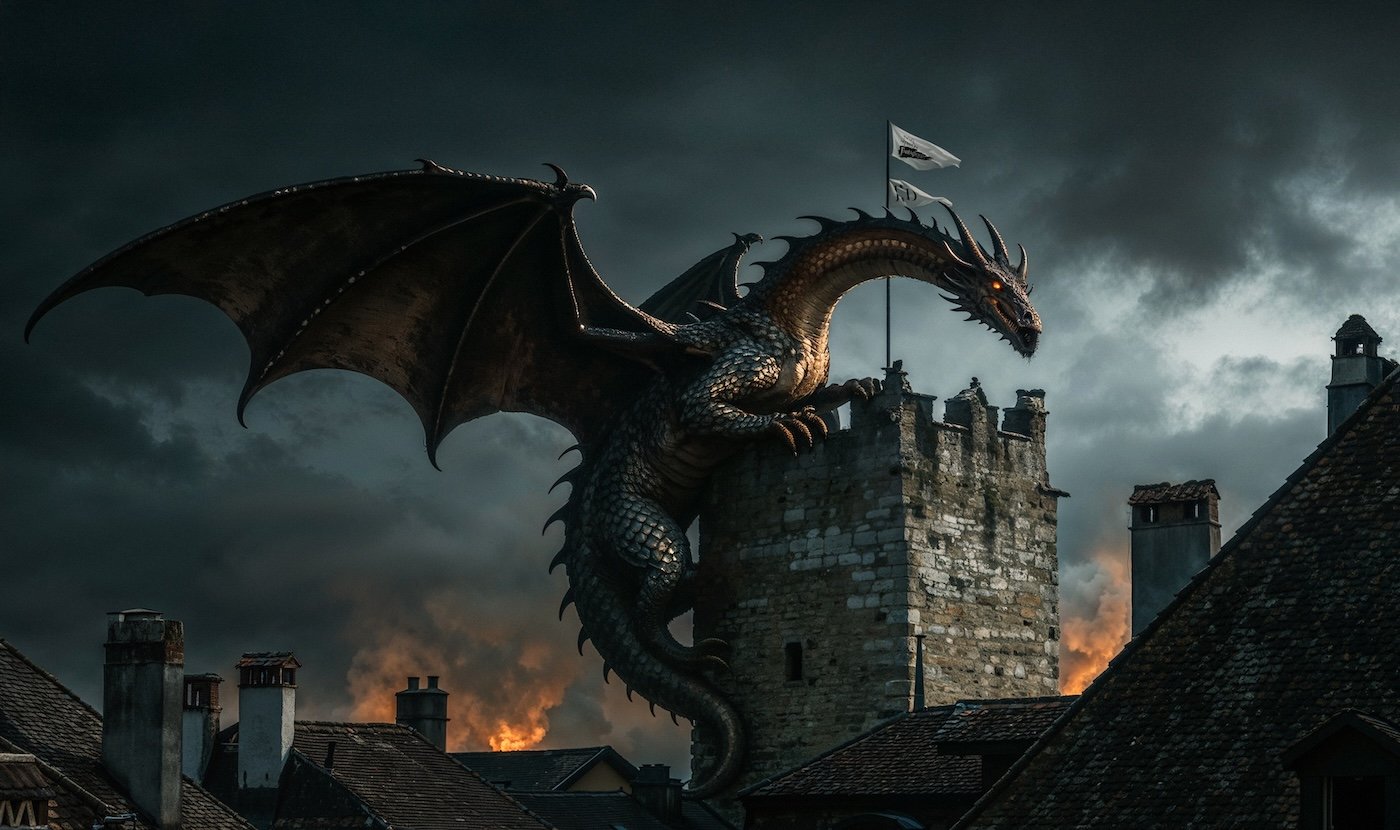
Among the outcomes of this dialogue is an automaton project inspired by a dragon, offered to collectors and designed to evolve with their commissions - much like the series revisiting the complete discography of the Rolling Stones, themselves part of the “Jaquet Droz family”: a shared theme, yet each piece remains unique. Deeply impressed by the artisans’ expertise, John Howe simply remarked: “I bow to such talent.”
-

- For Jaquet Droz, John Howe has envisioned the emblematic creature of his universe - the dragon - offered to the brand’s clients in multiple unique iterations, such as this white gold tourbillon version.

In its effort to forge closer ties with the broader art world, the maison is also opening its doors to emerging talent. A partnership with the Académie de Meuron invites students to submit projects to be realised by Jaquet Droz. One will be selected and produced as a unique piece for the TimeForArt charity auction organised by the Swiss Institute in New York at year’s end.
-

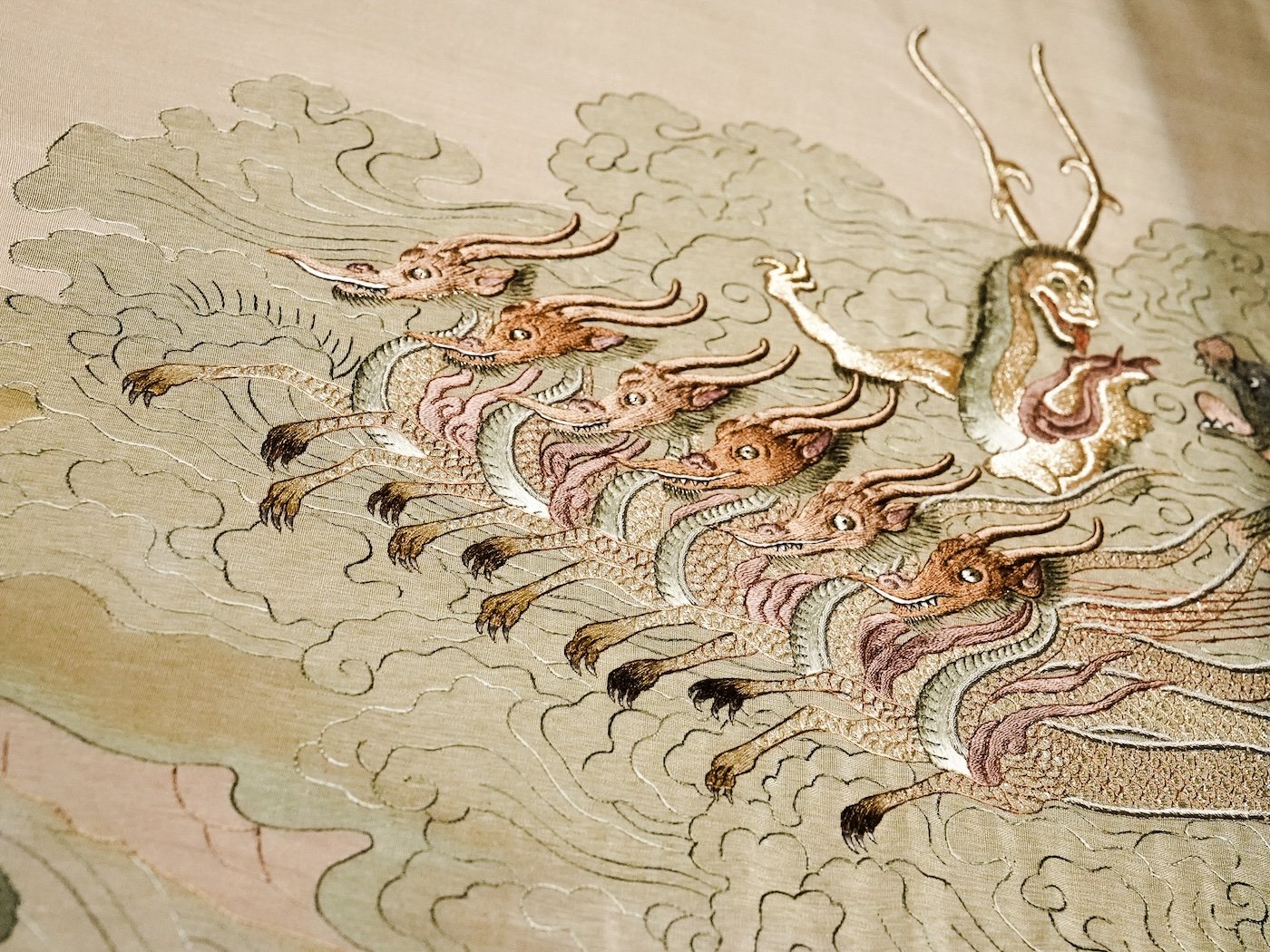
- The Luo River Automaton finds its origin in the work of Wang Limin, heir to the Quejinxiu embroidery tradition, renowned for her mastery of gold thread and its associated techniques - dyeing, painting and inlay. For this creation, nearly all of Jaquet Droz’s artisans were called upon: engraving, sculpture, painting, gem-setting and watchmaking.
-

- Inspired by a 3rd-century poem and a painting from the following century, Wang Limin set out to write a new chapter celebrating time as a flowing river, eternal love, the quest for immortality, and her own art - woven with silence and discipline. At the heart of the piece, the hours are displayed on a dial of pale imperial jade, brought to life by two red gold hands. Surrounding it, a rotating ring (30 seconds) in micro-painted mother-of-pearl evokes the passage of water and time, while a carp comes to life on demand.
Watchmaking beyond category
Such an ultra-personalised approach - without physical retail - poses a clear challenge: how to establish and nurture relationships with collectors. Jaquet Droz’s answer lies in discretion and proximity. “We host private dinners with no more than six or seven collectors at a time,” explains Delamuraz. “Relationships are built over years. Ultimately, commissions take shape in one-to-one encounters.”
Operating outside traditional retail circuits, but supported by ambassadors and trusted intermediaries, the brand relies on highly personalised client follow-up - often leading, in time, to new clients. The model draws more from luxury hospitality than from conventional watch distribution. Unsurprisingly so: the CEO is a former director of Lausanne’s Beau-Rivage Palace. “At hotel school, you learn one essential rule: bring your clients back before looking for new ones.”
-

- In Wang Limin’s atelier, where the strap of the Luo River Automaton was entirely hand-embroidered.

Family narratives frequently lie at the heart of these encounters: a significant share of commissions depict a family, a family symbol, or are conceived as heirlooms for future generations.
In this vision, Jaquet Droz no longer positions itself as a traditional watchmaker. “Our competitors are not other watch brands. They are yacht builders or helicopter manufacturers,” Delamuraz concludes. A deliberately asserted, hyper-exclusive stance.
“If we elevate watchmaking towards art, everyone benefits. Some clients will start with us and then move on to other maisons. It is not one or the other - it is both.”