


 Español
 Français
 Pусский
 繁體中文
繁體中文 简体中文
简体中文 Select another language


he TAG Heuer Monaco Evergraph project did not emerge from a purely aesthetic or technical pursuit. It is rooted in a broader strategic reflection undertaken by the brand on the evolution of its movements across all collections.
“This development began five years ago and reflects our overall strategy around movements and customer expectations,” explains Carole Forestier-Kasapi, Director of Movement Strategy and Haute Horlogerie. “The market has shifted toward a new normal in terms of durability, quality and performance. We’ve already seen this with solar quartz, five-year warranties and ten-year service intervals. With the Tag Heuer Monaco Evergraph, we are applying this logic at the very top of the pyramid: Haute Horlogerie.”
This ambition is expressed through a set of technical features designed to enhance the overall performance of the timepiece: the TH-Carbonspring oscillator with a carbon hairspring offering resistance to magnetism, a high frequency of 5 Hz, COSC certification and a power reserve sufficient to cover an entire weekend.

“We wanted outstanding chronometric stability, even on the wrist, despite shocks or acceleration. The goal was to push further what a chronograph can be today.”
A break from tradition in architecture
The most radical change concerns the chronograph’s very architecture. The bistable flexible mechanism developed by the TAG Heuer LAB replaces traditional solutions based on column wheels, levers and springs. “You almost have to forget everything you knew about traditional chronographs,” emphasises Carole Forestier-Kasapi. “We started from a blank sheet to completely rethink the experience.”
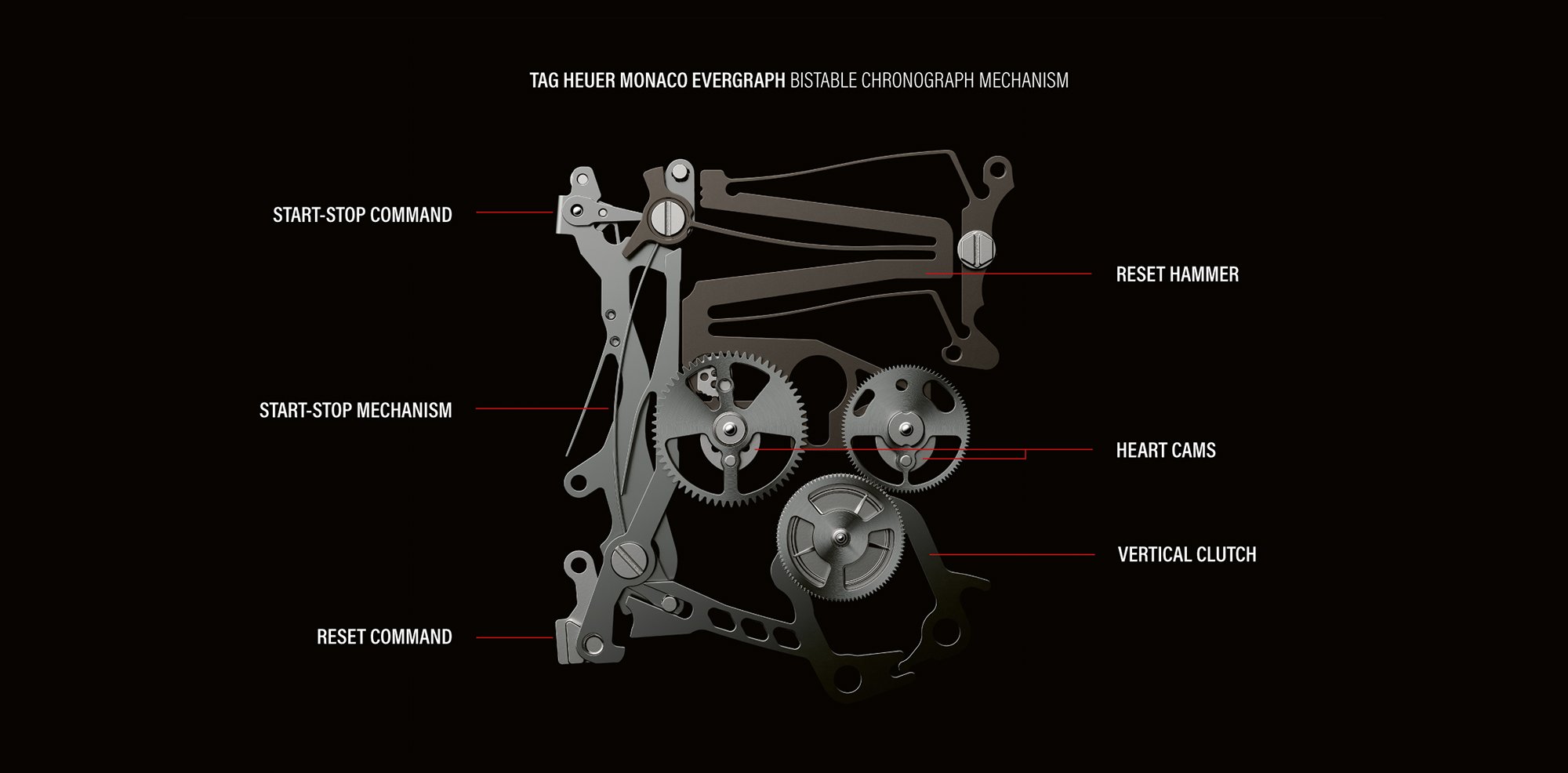
This new architecture relies on two bistable flexible components that respectively handle the start/stop and reset functions. This approach significantly reduces the number of moving parts and friction points.

“There is far less wear and friction. In a traditional chronograph, the forces applied to levers or the column wheel are substantial and create wear points. Here, we have eliminated most of those mechanical constraints.”
This simplification also has a direct impact on durability and adjustment stability. “Traditional chronographs include many adjustments to regulate the engagement between components. And any adjustment implies a risk of misalignment over time. By reducing contact points and adjustments, we also reduce those risks.”
Fully rethought ergonomics
Beyond mechanics, the TAG Heuer team paid particular attention to the user experience. The ergonomics of the pushers and the tactile feel were the subject of extensive studies. “We conducted numerous customer studies, especially on ergonomics and the acoustic signature of the pushers. The objective was to achieve a crisp and consistent feel, regardless of the pressure applied.”
The pushers have thus been redesigned with a shape that is better suited to finger morphology, while the bistable mechanism ensures identical feedback over time: whether on the very first press or the ten-thousandth.

Nothing was left to chance in this ergonomic quest: Carole Forestier-Kasapi personally visited numerous exhibitions and auctions alongside Nicholas Biebuyck, TAG Heuer’s Heritage Director, to test the pusher experience of historical chronographs. The verdict? “The experience will be entirely new for users.”
A dual-headed organisation with Vaucher Manufacture Fleurier
The project is also the result of an unprecedented mode of collaboration between TAG Heuer and Vaucher Manufacture Fleurier: “The design was shared. The entire chronograph mechanism and the carbon oscillator were developed by TAG Heuer, while the rest of the movement was produced with Vaucher Manufacture Fleurier. We invented a dual-headed way of working, with a shared 3D cloud-based vision where everyone worked simultaneously on their respective parts.”
The initial research was carried out within the TAG Heuer LAB. The bistable principle quickly established itself: “We had already explored this type of system in the lab, particularly bistable resonators developed within the group. Early partial prototypes enabled us to confirm we were on the right track.” The development of Calibre TH80-00 required an especially intensive validation programme, as Forestier-Kasapi confirms: “We conducted more than 300 laboratory tests to certify this calibre.”
Calibre TH80-00 and LIGA technology
In concrete terms, the chronograph mechanism of Calibre TH80-00 is based on two bistable flexible components made of a nickel alloy. The first, linked to the pusher at 2 o’clock, controls the start and stop functions of the chronograph. It replaces traditional devices such as the column wheel or cam and acts as an interface between the pusher and the vertical clutch, which couples or uncouples the chronograph from the gear train.
When the start/stop pusher is activated, the bistable element switches and opens the vertical clutch, allowing the chronograph to engage with the timekeeping train. In this configuration, the system mechanically blocks the reset function to prevent any reset while the chronograph is running.
A second press on the start/stop pusher switches the mechanism to its second stable position. The clutch then closes, stopping the chronograph and disengaging it from the movement. When the chronograph is stopped, the user can activate the pusher at 4 o’clock. This controls a second bistable component acting as a reset hammer. When it switches, this mechanism strikes the heart-shaped cams of the chronograph’s seconds and minutes counters, instantly returning the hands to zero.

To achieve the level of precision such a mechanism requires, these components are manufactured using LIGA (Lithography, Galvanoformung, Abformung) technology. This microfabrication process, derived from micro-engineering technologies, enables the production of extremely fine metal structures with micrometric precision. It also allows the creation of complex geometries that are difficult to achieve with conventional machining methods.
With regard to Calibre TH80-00, LIGA technology enables monobloc flexible structures capable of providing both the mechanical function and the elasticity required for bistable operation.
The next chapter of TH-Carbonspring
This unprecedented architecture is complemented by another major innovation: the integration of the TH-Carbonspring oscillator, a carbon hairspring developed by TAG Heuer and unveiled last year. This material offers several decisive advantages for a mechanical movement. Its lightness and structural stability improve oscillation regularity, while its physical properties provide strong resistance to magnetic disturbances.
Combined with a frequency of 5 Hz, or 36,000 vibrations per hour, this oscillator helps reinforce the movement’s chronometric stability, even under dynamic conditions of use.
An inverted construction to reveal the mechanics
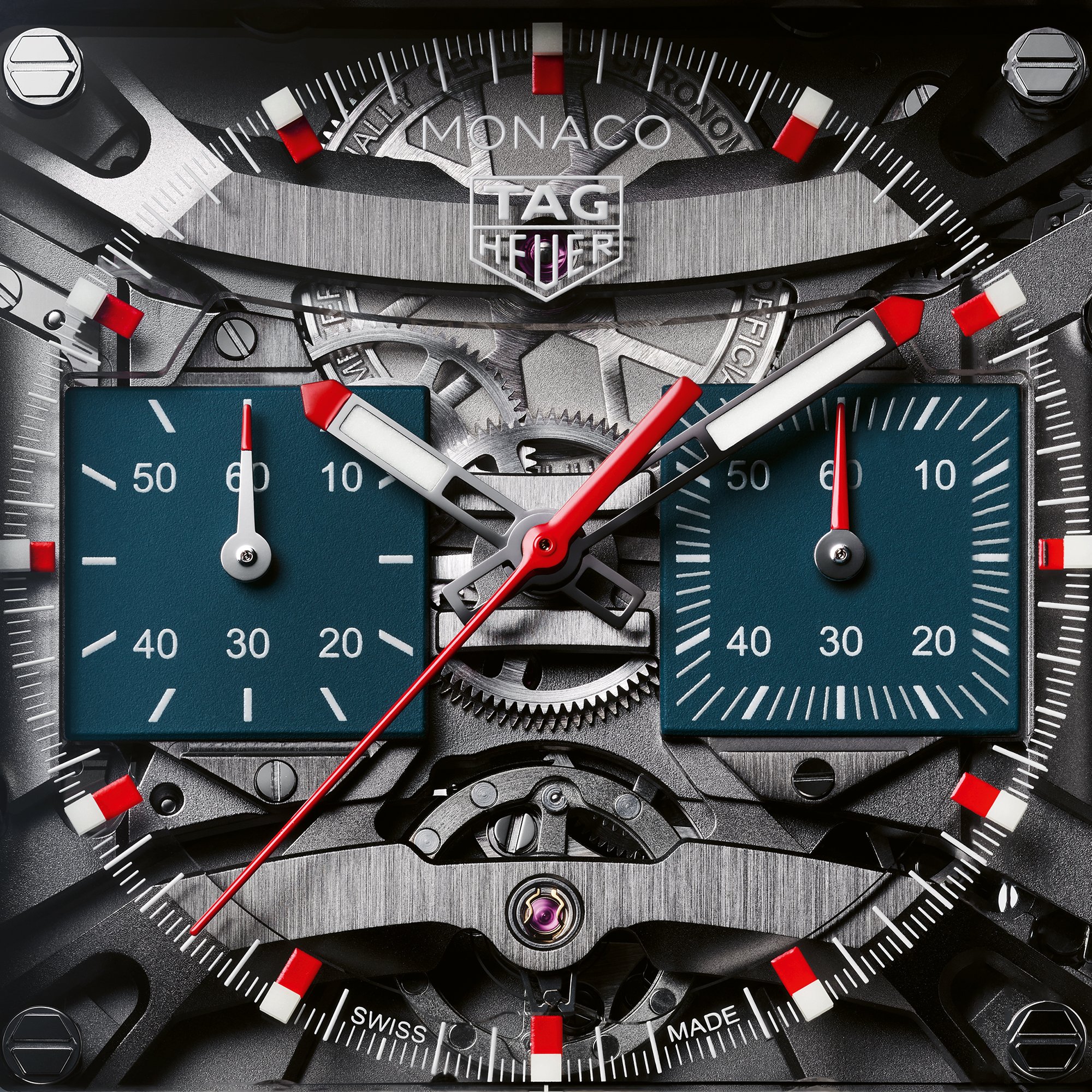
The TAG Heuer Monaco Evergraph adopts an inverted architecture that places the key elements of the movement on the dial side. A radically different approach from the traditional version: “In the classic TAG Heuer Monaco, the dial is closed. Here, we wanted to showcase the movement and chronograph information directly on the dial side,” explains Carole Forestier-Kasapi.
Accordingly, a transparent central dial reveals the barrel, gear train, TH-Carbonspring oscillator and escapement. On the reverse side, the watch reprises certain aesthetic codes introduced with Calibre TH81-00 of the TAG Heuer Monaco Split-Seconds, notably the signature chequered-flag pattern and the shield-shaped oscillating weight.

The case design builds on work initiated with the split-seconds model, pushing ergonomic considerations even further. The silhouette remains faithful to the original 1969 model (reference 1133), while being subtly redesigned to improve wrist comfort and movement integration.
Large structural arches support the barrel and balance, while the two subdials for chronograph minutes at 3 o’clock and small seconds at 9 o’clock create a visual symmetry that balances the whole. The transparent dial gives the impression that the indications are floating within the case.
A signature introduced in 1969 with Calibre 11, the crown retains its position on the left. The pushers, however, have been redesigned: more elongated, they enhance ergonomics and enable more natural interaction with the chronograph function.

The 40mm grade 5 titanium case has also been reworked. Tapered profiles create a sense of slimness, while angular facets along the sides give the watch a strong architectural presence, almost brutalist in character. The square sapphire caseback offers a full view of the movement, specifically designed to fit within the Monaco’s iconic architecture.
Two versions are offered, priced at CHF 23,000. The first, in natural titanium with blue accents, pays tribute to the Heuer Monaco reference 1133B made famous by Steve McQueen. The second, in black DLC-coated titanium with red accents, draws more directly from the world of motorsport and TAG Heuer’s racing DNA.

A Haute Horlogerie development
TAG Heuer doesn’t intend the mechanism showcased in the Evergraph to replace the traditional chronograph architecture within the TAG Heuer Monaco collection. The new bistable flexible mechanism remains, for now, reserved for this Haute Horlogerie project. The model’s history and identity matter, and classic chronographs will continue to exist in their traditional configuration. The brand nevertheless feels compelled to explore new paths. As a historic pioneer of the chronograph, TAG Heuer has a duty to question the very foundations of this complication.
Even if broader industrialisation would be technically feasible, strategic choices must also take into account heritage and positioning. What is certain is that the project opens new perspectives for the brand and for chronograph design. “The most important thing is to move forward step by step, staying focused on the customer and on real performance,” concludes Carole Forestier-Kasapi. With the TAG Heuer Evergraph, the brand demonstrates that it is still possible to completely reinvent a historic complication—to give it a new destiny, perhaps as “everlasting” as its name suggests.
TAG HEUER: A CENTURY AND A HALF OF CHRONOGRAPHS
Few watchmaking houses maintain as close a relationship with the chronograph as TAG Heuer. As early as 1887, Edouard Heuer made history with the patent for the oscillating pinion, a device that significantly simplifies chronograph engagement and remains one of the most widely used mechanical principles in watchmaking today.
At the beginning of the twentieth century, the company developed time-measuring instruments for scientific, medical and sporting applications. In 1908 the Sphygmometer introduced a pulsation scale enabling doctors to measure heart rate. In 1911 Heuer presented its first dashboard chronographs for automobiles and aviation.
A true breakthrough came in 1916 with the Mikrograph, the first mechanical stopwatch capable of measuring 1/100th of a second. This innovation revolutionised sports timing and firmly established Heuer as a reference in the field.

The 1960s, under the leadership of Jack Heuer, marked a new golden age. The brand launched now-iconic models, notably the Autavia and the Carrera, closely linked to the world of motorsport.
In 1969 Heuer reached a decisive milestone with the Monaco, first square, water-resistant automatic chronograph. Powered by the Calibre 11, one of the first commercially available automatic chronograph movements, it immediately became a symbol of watchmaking avant-garde.
At the same time, the brand strengthened its ties with motor racing, becoming the first watchmaker to appear on a Formula 1 car, notably alongside Jo Siffert.
Over the decades, TAG Heuer has continued to explore the frontiers of high frequency and precision, with experimental projects such as the Mikrotimer Flying 1000 and the spectacular Mikrogirder, capable of measuring 5/10,000ths of a second.
In 2026, with the TAG Heuer Monaco Evergraph, the brand once again revisits the chronograph—not merely by improving its performance, but by rethinking its very architecture. An evolution that confirms the central role of this complication in TAG Heuer’s technical identity.


