


 Español
 Français
 Pусский
 繁體中文
繁體中文 简体中文
简体中文 Select another language


here are two sides to Blancpain. One is firmly sports-oriented with the relaunch, in the early 2000s by the brand’s President & CEO Marc A. Hayek, of the Fifty Fathoms dive watch from 1953. The other is characteristic of the watchmaking associated with Vallée de Joux, the world-renowned home of classical and complicated timepieces.
The Fifty Fathoms has inspired several innovations, including the Fifty Fathoms 70th Anniversary Act 2 – Tech Gombessa, developed by Blancpain with French diver and marine biologist Laurent Ballesta. Engineered for today’s longer dives with a rebreather, it is the first dive watch to measure immersion times of up to three hours.
This same innovation extends to the brand’s more classical facet. Eight years ago, Marc A. Hayek set Blancpain on a course to create its first grande sonnerie. His ambition, however, was not simply to join the rarefied circle of Manufactures capable of creating this ultimate complication. His aim was to redefine what it could be.
-

- Marc A. Hayek, Blancpain President & CEO
Almost a decade later, from its historic farmstead in Le Brassus, Blancpain has revealed the result of these many years of research. The Grande Double Sonnerie is the first wristwatch that sounds the time with two separate melodies: the famous Westminster chimes and an original composition, named what else but Blancpain, by Eric Singer, the drummer with rock band KISS.
“The Grande Sonnerie is one of the most difficult complications to create. It is the queen of watchmaking complications. I wanted a Grande Sonnerie that the owner could comfortably wear, not a demonstration of technique that would merely reside in a safe. Most of all, it had to change our conception of the chimes themselves, hence there was no timeframe for development. And as you can imagine, it took time! This is a testament to the work of an entire team,” Marc A. Hayek declared.

A complete rethink
On paper, the project seemed impossible to achieve. Not only did Blancpain want to sound the hours and the quarters on four separate notes – E, G, F and B –, these four notes had to form a melody rather than the simple alternating between two notes used by minute repeaters. Compounding the difficulty, there would be not one but two melodies - the historic Westminster chimes and an exclusive Blancpain melody - selected at the simple push of a button.


The Le Brassus watchmakers were in uncharted territory. As they explained when we visited the Manufacture, three prototypes of the 15GSQ calibre were made: one for the finishing and time-setting; another for the chiming mechanism and a third for the complete movement, which also incorporates a flying tourbillon and a retrograde perpetual calendar. Eight years of research, 21 patents, 1,053 components and a fully integrated movement culminated in this mechanical masterpiece, which is nothing less than the most complicated watch in Blancpain’s history.
The Westminster chimes, most closely associated with the Palace of Westminster in London, are played on four notes. The four quarters of each hour form a sequence that is rarely reproduced in a watch. Each hour on the hour, the Grande Double Sonnerie plays the complete musical motif, offering the wearer the rare experience of a miniature concert.
-

- What seemed impossible on paper - sounding the time on two four-note melodies, the classic Westminster chimes and an original composition by Eric Singer, and switching from one to the other at the push of a button – becomes reality and a watchmaking first with the Grande Double Sonnerie.
The Blancpain melody was written by Eric Singer, a seasoned watch collector and close friend of Marc A. Hayek. Renowned as the drummer of KISS, he accepted the challenge to transform the four notes into an original musical signature. This was no small task, as Singer had to work within the technical limitations imposed by the movement and, by his own admission, when the Blancpain team showed him the specifications, “I didn’t understand a single word of what was in there.”

“What really turned out to be a challenge was realising there were only four notes available,” Singer adds. “That might sound like a lot for a watch, but for a musician, it’s an immense limitation. Turning that constraint into music was the real puzzle, and also what made this collaboration so fascinating.”
In a world-first, a column wheel mechanism switches between the two melodies at the press of a button.
The delicate art of perfect harmony
Transforming the concept into music required Blancpain to rethink every acoustic parameter, if the melody were to sound on pitch-perfect notes and with absolute precision in terms of tempo. When sounding on just two notes, small irregularities go undetected by the human ear; with a melody, however, the slightest irregularity is perceived as discordant.
After months of testing eleven different alloys, Blancpain chose gold for the gongs, for their pure resonance and harmonic depth. Their variable geometry (one of the movement patents) allows the watchmaker to modulate their frequency in precisely the same way a luthier adjusts a guitar’s soundboard. The frequency of each gong is measured using a laser and microns shaved from its tip until the exact note is obtained.

Blancpain’s engineers also developed a gold acoustic membrane to enhance sound transmission. Fitted in the bezel, this galvanically grown membrane is 80 microns thick and acts as a natural soundboard while preserving the watch’s water-resistance and mechanical integrity. A flexible ring ensures optimal transmission of low frequencies. This is a radical rethinking of a watch’s architecture and how it affects acoustics.
Complete security
A complication of this ilk warrants careful handling, hence Blancpain has incorporated five safety systems, also patented, which protect against incorrect use during setting or winding, thus ensuring peace of mind for the wearer.

Two separate barrels supply power to the timekeeping mechanism and the striking mechanism, offering 96 hours of power reserve and a continuous 12 hours of chimes in grande sonnerie mode. Even with such a remarkably complex movement, having tried it on I can say that the Grande Double Sonnerie wears comfortably, measuring 47mm across and 14.5mm thick.
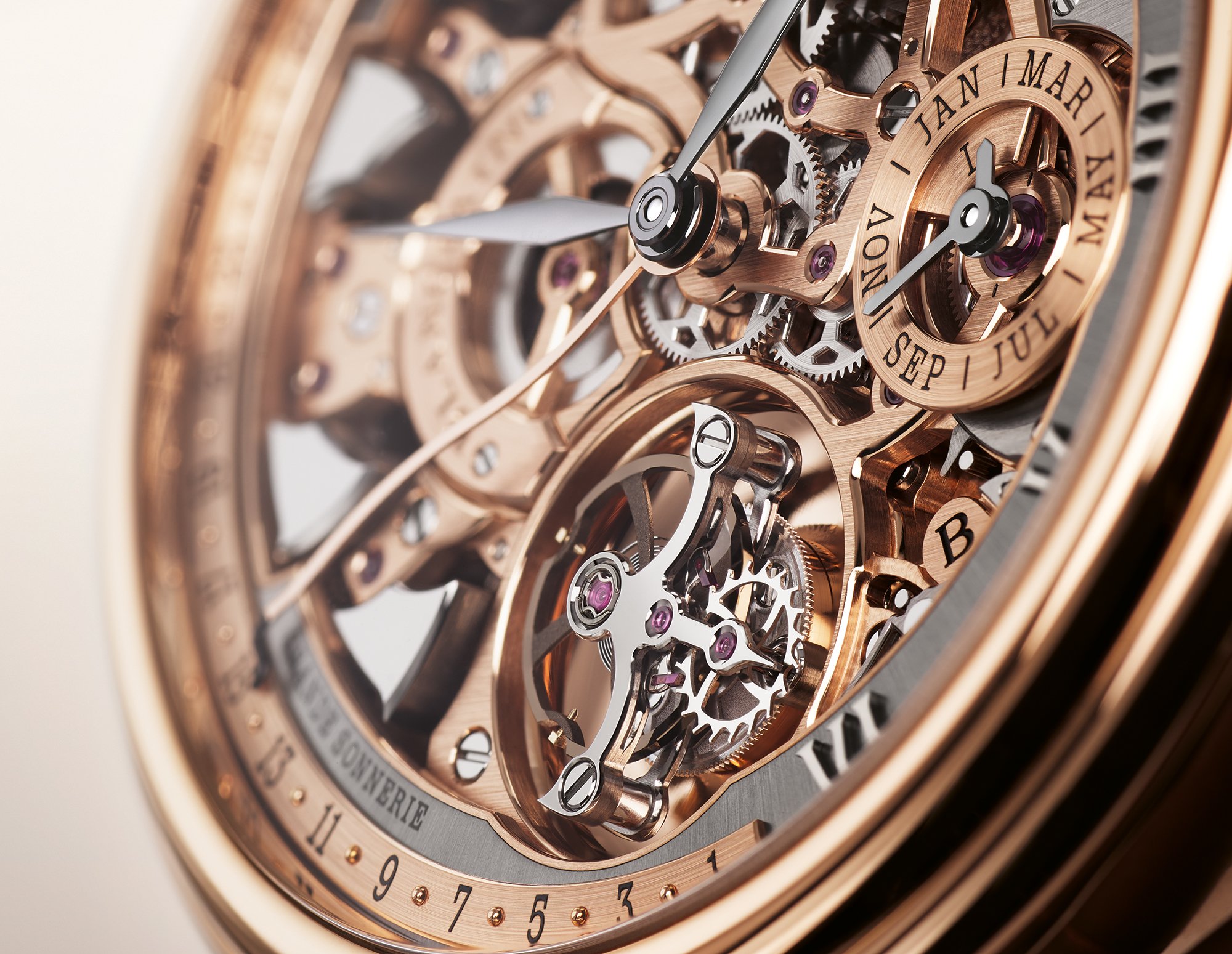
Blancpain introduced the first flying tourbillon in a wristwatch in 1989 and this complication also appears in the Grande Double Sonnerie, enhanced with a higher frequency of 4 Hz and a silicon balance spring. The absence of an upper bridge affords a clear view of the regulator in motion and, beyond chronometric performance, the mirror-polished surfaces, deep chamfers and gold cage are a marvel to behold.
Integrated perpetual calendar
So as not to detract from legibility or compromise the movement structure, Blancpain’s engineers have achieved the rare feat of incorporating the retrograde perpetual calendar into the movement, as opposed to a separate module.
This unique architecture displays the calendar indications without obscuring the view of the hammers. Adjustments are made without tools, just a fingertip, via the patented under-lug correctors which have been redesigned and incorporated into the movement.

Bridges, plate, hammers, levers… every part of the Grande Double Sonnerie is decorated by hand. The 18k gold movement includes 26 bridges and 135 inner angles, a record number at Blancpain. In the purest Vallée-de-Joux tradition, each of these crisp angles has been polished with the stems of wild-growing gentian wood.
For each movement, some 450 hours are spent decorating 255 components, with the help of 270 separate tools. The perlage of the mainplate alone takes four full days, forming each circle to a diameter of 0.7 millimetre. Haute Horlogerie requires that even the invisible parts are decorated: a pleasure reserved for the watchmaker who might one day open the watch and discover the hidden treasures inside.
One or two pieces a year
Notwithstanding its remarkable technical sophistication, the Grande Double Sonnerie is made to be worn. Tested to 5000G, it is robust enough for daily wear. Cased in red gold or white gold, the 35.8mm movement presents a spectacular architecture that reveals the hammers for the chimes and the tourbillon cage through a sapphire crystal.

Each Grande Double Sonnerie is assembled from start to finish by one of two watchmakers who, on completion, signs his work on a gold plaque mounted on the movement. It is a labour of love over twelve months: four months of preparation and eight months assembling and adjusting – including the acoustic fine-tuning carried out by ear and with a sapphire file. Understandably, only one, at the very most two, of these masterpieces will be produced each year. Blancpain also offers personalisation to the future owner’s requirements.

As befits such a rare instrument, the Grande Double Sonnerie is presented in a box crafted from resonance spruces that grow in Risoud Forest in Vallée de Joux. Prized by luthiers for its acoustic qualities, here the wood serves as a natural soundboard but also intensifies the connection between the timepiece and the valley from where it originates. More than a presentation box, it is an integral part of the acoustic experience.
“This is the complication Blancpain had yet to create. The grail of Haute Horlogerie,” Marc A. Hayek concludes. “Not as a demonstration of skill but to spark emotion. Harmony rather than performance. The beauty of perfect sound.”


